Blackbar Soldierfish
Myripristis jacobus
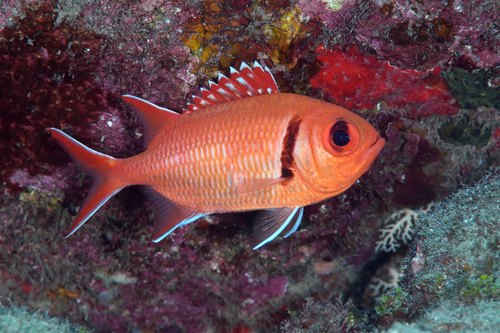
A crimson jewel of the night, the Blackbar Soldierfish is famous for its massive eyes and the striking dark 'shoulder' stripe that gives it its name.
Quick Identification
Size
Typically 15-20 cm (6-8 inches), reaching a maximum length of 25 cm (10 inches).
Colors
Bright red to deep pink body with a prominent, vertical dark brown or black bar immediately behind the gill opening; fins often have white leading edges.
Key Features
- Distinctive vertical black bar behind the gill cover
- Extremely large, dark eyes for nocturnal vision
- Deeply forked tail fin
- Bright red or rosy-pink coloration
When You’ll See Them
Geographic range
Where Does the Blackbar Soldierfish Live?
Native to the tropical Western Atlantic, the Blackbar Soldierfish is commonly found from the waters of Florida and the Gulf of Mexico through the Caribbean Sea down to the coast of Brazil. While its primary stronghold is the Americas, it also maintains established populations across the ocean in the Eastern Atlantic, specifically around the Cape Verde Islands and Saint Helena. It is a signature species of Caribbean reef systems, thriving wherever there is complex coral architecture.
Basemap © OpenStreetMap contributors
Behavior
The Blackbar Soldierfish is a primarily nocturnal species that spends its daylight hours in the shadows. During the day, they are most often seen in small, hovering groups within the protection of coral crevices, caves, or under ledge overhangs. They exhibit a fascinating ability to swim upside-down when navigating the ceilings of these underwater caverns, maintaining their orientation relative to the solid surface rather than gravity.
When night falls, these fish become solitary and bold, venturing away from the reef structure and into the open water column to feed. While they are generally shy around divers during the day, they are less easily spooked at night when they are focused on hunting. They are social among their own kind but do not form the massive schools seen in some other reef species, preferring loose aggregations.
EverydayEarth exclusive
Camera Tips
To successfully capture the Blackbar Soldierfish on an underwater camera, focus on 'structure' rather than open water. During the day, place your camera on a weighted tripod or mount it near the entrance of a reef crevice or a large coral overhang. These fish love shadows; angling the camera slightly upward into a cave ceiling will often reveal them hovering in their characteristic 'upside-down' position. Because they stay relatively still during the day, this is the best time for high-resolution still photography.
For nighttime capture, which is when the species is most active, lighting is your biggest challenge. Use a camera with an infrared (IR) flash or a very low-power, wide-angle video light to avoid overexposing their highly reflective red scales. Red light is particularly effective because many reef fish cannot see it, allowing you to capture natural foraging behavior without startling them. Position the camera near the reef edge where the fish emerge at dusk.
If you are setting a camera near a coastal dock or pier, look for vertical pilings with heavy growth. Blackbar Soldierfish often use these as 'artificial reefs.' Ensure your underwater housing is clean and use a 'narrow' or 'linear' field of view if possible to avoid the distortion of wide-angle lenses, as these fish are relatively small. A 20-second video trigger is ideal, as it captures the jerky, rhythmic swimming style that distinguishes them from the smoother-moving squirrelfish.
Similar Species
Species that look similar or are commonly confused with Blackbar Soldierfish.
Frequently Asked Questions
Record Blackbar Soldierfish at your habitat
Connect a camera to start building your own species record — AI identifies every visitor automatically.