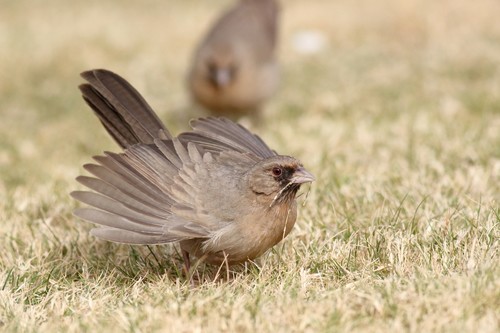
Abert's Towhee
Melozone aberti
A secretive specialist of the desert Southwest, the Abert's Towhee is a master of the undergrowth. With its soulful black mask and charming ground-scuffing habits, it's a favorite for backyard birders in the Sonoran region.
Quick Identification
Size
Length: 8.3–9.8 in (21–25 cm); Wingspan: 10.5–11.5 in (26.7–29.2 cm); Weight: 1.3–1.9 oz (36–53 g)
Colors
Uniform grayish-brown to cinnamon-buff body; distinct black mask around the base of the bill; pale bill; males and females look identical.
Key Features
- Distinct black 'mask' around the base of the bill
- Cinnamon-colored undertail coverts
- Long, rounded tail
- Thick, pale seed-cracking beak
When You’ll See Them
Geographic range
Where Does the Abert's Towhee Live?
The Abert's Towhee is a true specialist of the North American Southwest, finding its home primarily within the lush riparian corridors of the Sonoran Desert. Its range is tightly concentrated around the lower Colorado and Gila River watersheds, making it almost entirely endemic to Arizona, though it extends its reach into parts of southeastern California, southern Nevada, southwestern Utah, and western New Mexico. In Mexico, these birds are found throughout the northern stretches of Sonora, where they thrive in the dense undergrowth of desert washes and irrigated valley landscapes.
Basemap © OpenStreetMap contributors
Behavior
Abert's Towhees are the quintessential 'skulkers' of the bird world, often heard before they are seen. They spend the vast majority of their lives on the ground, scratching through leaf litter with a characteristic 'double-scratch' hop to uncover insects and seeds. While they are socially monogamous and often stay with the same partner year-round, they are quite secretive, preferring to stay within the protective cover of dense brush or desert scrub.
In suburban settings, they have adapted remarkably well to 'urban riparian' habitats—think well-watered backyards with plenty of ornamental shrubs and leaf mulch. They are generally peaceful but can be territorial around their preferred foraging spots. Unlike many other birds, they rarely fly long distances, preferring to hop or run between covers, which makes them an excellent subject for ground-based wildlife cameras.
EverydayEarth exclusive
Camera Tips
To capture the best footage of Abert's Towhees, you must focus on ground-level placement. These birds are heavy-bodied sparrows that spend nearly all their time under the canopy of shrubs. Mount your AI-powered camera 6 to 12 inches off the ground, angled slightly upward or parallel to a clear patch of dirt or mulch near dense bushes like Pyracantha or Mesquite. This 'to-the-floor' perspective captures their unique foraging behavior and ensures the black facial mask is clearly visible.
Water is the ultimate magnet for this species in the arid Southwest. A ground-level bird bath or a slow-dripping fountain will consistently draw them into the camera's field of view. For food-based lures, avoid hanging feeders, which they rarely use. Instead, scatter white proso millet, sunflower hearts, or cracked corn directly on the ground. Creating a 'foraging zone' by lightly piling leaf mulch in front of the camera will encourage them to perform their characteristic double-scratch kick, making for highly engaging video clips.
Because Abert's Towhees prefer the shade of thickets, lighting can be a challenge. If possible, position your camera so the background is naturally lit but the foraging area is in soft shade; this prevents the bird's earthy tones from being washed out by the harsh desert sun. High-sensitivity settings or a fast trigger speed are recommended, as their movements are quick and jerky. Early morning and late afternoon provide the best light for highlighting the subtle cinnamon hues of their plumage.
Similar Species
Species that look similar or are commonly confused with Abert's Towhee.
Frequently Asked Questions
Record Abert's Towhee at your habitat
Connect a camera to start building your own species record — AI identifies every visitor automatically.