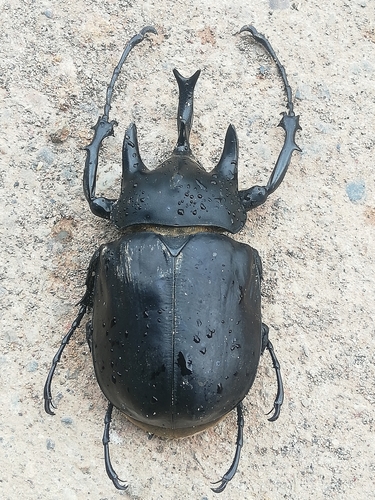
Actaeon Beetle
Megasoma actaeon
One of the heaviest insects on the planet, the Actaeon Beetle is a matte-black titan of the Amazon. With its prehistoric horns and armored body, it is a true heavyweight of the tropical night.
Quick Identification
Size
Length 5–13.5 cm (2–5.3 inches); weight up to 50g (1.8 oz) as adults
Colors
Uniform matte black or very dark brownish-black; males have large horns, females are hornless
Key Features
- Massive, heavy-bodied matte black appearance
- Male has a long, forward-curving head horn and two thoracic horns
- Legs equipped with powerful, oversized claws for climbing
- Exoskeleton has a dull, non-reflective finish compared to other giants
When You’ll See Them
Geographic range
Where Does the Actaeon Beetle Live?
This spectacular beetle is a native icon of the South American tropics, with a range centered deep within the Amazon Basin. It is most commonly found in the lush rainforests of Brazil, Peru, Colombia, and Ecuador, extending north into the Guianas and south into parts of Bolivia. Because they rely on large, decaying trees for their long larval cycle, they are typically restricted to areas with healthy, old-growth forest cover.
Basemap © OpenStreetMap contributors
Behavior
The Actaeon Beetle is a heavyweight champion of the insect world, often cited as one of the bulkiest beetles in existence. These giants spend the majority of their adult lives high in the rainforest canopy, though they are frequently drawn to the forest floor by the scent of fermenting fruit or sap. Despite their formidable appearance and massive horns, they are gentle giants that pose no threat to humans, using their strength primarily for navigating dense vegetation and competing for mates.
Males use their specialized horns in wrestling matches, attempting to lift and flip rival males off tree branches to secure breeding rights. They are surprisingly capable flyers, though their flight is loud and somewhat clumsy due to their immense body mass. They are primarily nocturnal, emerging at dusk to feed and find mates during the humid nights of the tropical rainy season.
EverydayEarth exclusive
Camera Tips
Capturing the Actaeon Beetle on camera requires a strategy focused on light and scent lures, as these beetles are strictly nocturnal. The most effective method is to set up a light trap—a bright UV or mercury vapor light shining against a white sheet—and position your camera on a tripod 3 to 5 feet away. Because they are heavy and slow-moving once they land, you can often get incredibly detailed macro shots if your camera is triggered by their arrival.
If you prefer a more natural setting, create a bait station by smearing a 'beetle mash' of overripe bananas, molasses, and a splash of yeast or beer onto a tree trunk. Position the camera at chest height, facing the bait, and use a PIR (Passive Infrared) sensor if your camera is sensitive enough for insects. Since the Actaeon Beetle is matte black, it absorbs light; you will need a gentle flash or an external LED fill light to prevent the beetle from appearing as a featureless silhouette against the dark bark.
Check your camera settings to ensure a fast enough shutter speed to capture their movement, as their legs are constantly searching for grip. A 'Macro' or 'Close-focus' setting is essential given their size relative to the frame. In the humid Amazonian environment, use desiccant packs inside your camera housing to prevent lens fogging, which is the most common cause of ruined shots during the peak rainy season when these beetles are most active.
Similar Species
Species that look similar or are commonly confused with Actaeon Beetle.
Frequently Asked Questions
Record Actaeon Beetle at your habitat
Connect a camera to start building your own species record — AI identifies every visitor automatically.