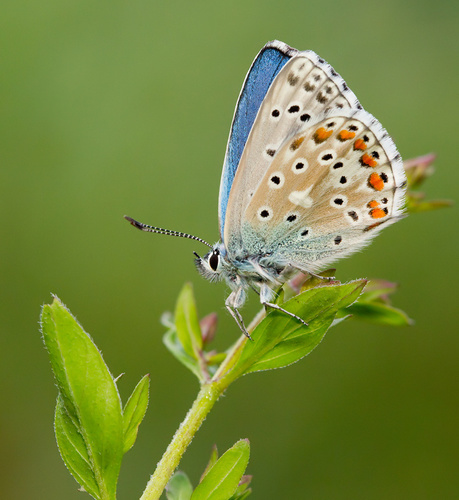
Adonis Blue
Polyommatus bellargus
A jewel of the chalk downs, the Adonis Blue is famous for the male's electric sky-blue wings and its remarkable partnership with ants. This specialist butterfly is a master of the sun-drenched hillsides of Europe.
Quick Identification
Size
Wingspan of 30–40 mm (1.2–1.6 inches); weight is negligible, typically under 0.5 grams.
Colors
Males are a brilliant, iridescent sky blue; females are chocolate brown with orange spots and a dusting of blue near the body. Both sexes feature a white wing fringe intersected by distinct black lines.
Key Features
- Brilliant sky-blue upper wings in males
- White wing margins distinctly chequered with black
- Underwings are grayish-brown with intricate black spots ringed in white
- Females have a row of orange crescents along the hindwing edges
When You’ll See Them
Geographic range
Where Does the Adonis Blue Live?
The Adonis Blue is primarily a European specialist, with its native range stretching across the southern and central parts of the continent into Western Asia. It thrives in the warm, calcareous downlands of Southern England, which marks its northernmost limit, and extends through France, Spain, and Italy into the Balkans and Turkey. While it is not an introduced species elsewhere, its populations are highly localized due to its strict dependence on specific soil types and host plants.
Basemap © OpenStreetMap contributors
Behavior
The Adonis Blue is a sun-loving butterfly known for its erratic, low-to-the-ground flight pattern. Males are particularly conspicuous as they flit over short turf in search of mates, often congregating in 'leks' on warm, south-facing slopes. They are highly sensitive to temperature, only becoming active when the sun provides enough warmth to power their flight muscles. During the heat of the day, they can be seen basking with wings spread wide to soak up solar energy.
One of the most fascinating aspects of their behavior is their symbiotic relationship with ants, specifically species like Myrmica sabuleti. The larvae secrete a sugary substance that ants crave; in exchange, the ants protect the caterpillars from predators and even carry them into their nests for safety during the pupation stage. This 'bodyguard' service is essential for the butterfly's survival in the wild.
EverydayEarth exclusive
Camera Tips
Capturing the Adonis Blue on an AI-powered backyard or trail camera requires a specialized setup because of their small size and specific habitat. For the best results, place your camera on a low-profile tripod or a ground mount, keeping the lens no more than 12 to 18 inches from the ground. Position the camera facing a patch of Horseshoe Vetch or popular nectar sources like Wild Thyme. Because these butterflies are cold-blooded, they are most predictable on south-facing slopes where the sun hits first in the morning.
To get clear images, use a camera with a macro lens or a very short minimum focus distance. If using a standard trail camera, look for 'close-focus' adapters. Set your camera to a high-speed 'burst' mode or high-frame-rate video (60fps or higher) to capture the rapid, fluttering movement of their wings. The brilliant blue of the male is highly reflective, so try to angle the camera slightly away from the direct midday sun to avoid 'blown-out' highlights that erase the wing detail.
Timing is everything for the Adonis Blue. They have two distinct 'broods' or emergence periods: one in late spring (May-June) and a second in late summer (August-September). During these windows, the best time to capture them is between 10:00 AM and 2:00 PM when they are most active. If you are using a motion-triggered camera, ensure the sensitivity is set to 'high' as their small frame may not always trigger standard PIR sensors. Providing a small, flat stone in a sunny spot can act as a natural 'lure,' as males will often land there to bask and regulate their temperature.
Similar Species
Species that look similar or are commonly confused with Adonis Blue.
Frequently Asked Questions
Record Adonis Blue at your habitat
Connect a camera to start building your own species record — AI identifies every visitor automatically.