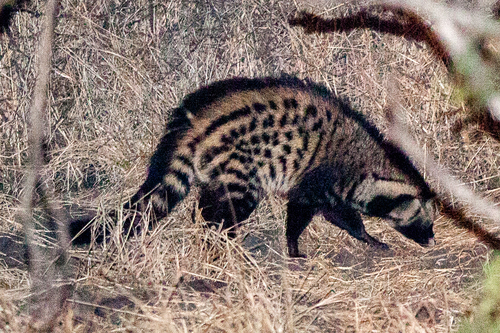
African Civet
Civettictis civetta
The African Civet is a striking, nocturnal mammal known for its bold black-and-white patterns and mysterious nature. As one of Africa’s most unique carnivores, this elusive visitor is a prized sighting for any backyard or trail camera enthusiast.
Quick Identification
Size
Total length of 100–130 cm (40–52 in) including the tail; weight typically ranges from 7 to 20 kg (15–44 lbs).
Colors
High-contrast coat featuring black spots, stripes, and blotches on a cream or yellowish-gray background; distinctive black 'raccoon-like' facial mask and solid black limbs.
Key Features
- Erectile dorsal crest that stands up when threatened
- Prominent black mask across the eyes and white neck stripes
- Large, bushy tail with dark rings and a black tip
- Sturdy, low-slung body with a dog-like snout
When You’ll See Them
Geographic range
Where Does the African Civet Live?
Native to the vast landscapes of sub-Saharan Africa, the African Civet occupies a massive range that stretches from Senegal in the west across to the horn of Africa in Ethiopia and Somalia. From there, its territory extends southward through the tropical heart of the continent into the northern reaches of South Africa, Namibia, and Botswana. While they thrive in a variety of environments, they are most frequently encountered in moist woodlands, riverine thickets, and forest-edge habitats where cover is plentiful.
Basemap © OpenStreetMap contributors
Behavior
The African Civet is a primarily solitary and nocturnal mammal that spends its nights foraging through the undergrowth. Unlike many other small carnivores, it is strictly terrestrial and rarely climbs trees. They are well-known for their unique 'civetries'—specific locations used as latrines where they also deposit secretions from their perineal glands to communicate with other individuals in the area.
When threatened, the African Civet can appear much larger than it actually is by raising a long crest of black hair along its spine. While they are generally shy and avoid direct human contact, they have adapted well to human-dominated landscapes, often venturing into gardens or farmsteads at night to hunt for rodents or scavenge on fallen fruit and refuse.
EverydayEarth exclusive
Camera Tips
To capture high-quality footage of an African Civet, place your camera low to the ground, approximately 30 to 50 centimeters (12 to 20 inches) high. These animals are strictly terrestrial and keep their noses to the ground while foraging, so a low angle provides the best view of their intricate facial markings and spots. Focus your efforts on 'civetries'—communal latrines that look like concentrated piles of scat; these are territorial hubs that civets visit almost every night.
Since civets are highly motivated by scent, using a pungent lure can stop them in their tracks for a better photo. Strong-smelling baits like canned sardines in oil or even a rag soaked in cheap perfume (simulating scent marking) can pique their curiosity. If you are in a suburban area, they are often attracted to the smell of fallen fruit or accessible pet food, though we recommend natural scent lures over feeding them directly.
Because the African Civet is almost exclusively nocturnal, ensure your camera has a high-quality infrared flash. Their high-contrast coat can sometimes 'white out' in overexposed night shots, so if your camera has adjustable flash settings, set it to a medium intensity or 'long range' to capture the detail of their spots without blowing out the highlights. A fast trigger speed or a 3-shot burst mode is ideal, as they tend to move with a steady, shuffling gait.
Seasonally, civets are active year-round, but you may see an increase in activity during the transition from the dry season to the wet season. During this time, the emergence of insects and amphibians provides a feast, and civets become more active as they take advantage of the abundance. Position your camera near water sources or along well-worn game trails leading from thick cover to open foraging areas.
Frequently Asked Questions
Record African Civet at your habitat
Connect a camera to start building your own species record — AI identifies every visitor automatically.