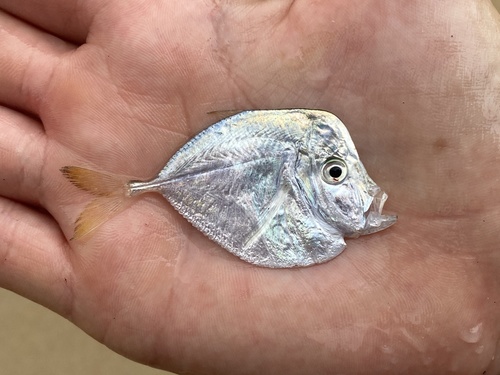
African Moonfish
Selene dorsalis
Witness the shimmering 'Phantom of the Atlantic.' With its paper-thin profile and metallic silver armor, the African Moonfish is one of the ocean's most striking examples of evolutionary camouflage.
Quick Identification
Size
Length up to 15 inches (38 cm), though typically 8-10 inches (20-25 cm); weight up to 3.3 lbs (1.5 kg)
Colors
Brilliant metallic silver or leaden hue across the entire body; occasionally exhibits a faint yellowish tint on the fins; translucent pelvic and dorsal filaments in juveniles
Key Features
- Extremely compressed, wafer-thin body
- Steep, nearly vertical forehead profile
- Lower jaw juts out beyond the upper jaw
- Deeply forked tail and long, sickle-shaped pectoral fins
When You’ll See Them
Geographic range
Where Does the African Moonfish Live?
The African Moonfish is native to the tropical and subtropical waters of the Eastern Atlantic Ocean. Its range hugs the coastline of West Africa, spanning from Senegal and the Cape Verde Islands in the north down to the Cape of Good Hope in South Africa. It is particularly abundant in the Gulf of Guinea, where it thrives in the nutrient-rich waters near the continental shelf.
Basemap © OpenStreetMap contributors
Behavior
The African Moonfish is a master of optical illusion. Its incredibly thin, disc-like body is designed for 'crypsis by silvering,' a specialized form of camouflage. By reflecting ambient light from its metallic scales, the fish becomes nearly invisible to predators and prey when viewed from the side, effectively blending into the shimmering water column of the open ocean.
These fish are highly social and are almost always found in large, synchronized schools. They frequent the shallow waters of the continental shelf, often hovering just above the sea floor. While they appear delicate, they are powerful swimmers capable of sudden bursts of speed to ambush small prey or evade larger predators like sharks and rays.
In terms of human interaction, they are a significant species for coastal fisheries across West Africa. They are not known to be aggressive, but they are wary; a school will often bank in unison to flash their silver sides as a deterrent or to confuse a perceived threat, a behavior that looks like a sudden underwater explosion of light.
EverydayEarth exclusive
Camera Tips
Capturing the African Moonfish on an underwater trail camera requires careful attention to light and positioning. These fish are benthic-oriented, meaning they spend much of their time near the bottom. For the best results, mount your camera 2-4 feet above a sandy or silty sea floor near a pier or natural reef edge. Angle the camera slightly downward to catch the school as they cruise through the lower third of the water column.
The biggest challenge with this species is 'backscatter' and glare. Their metallic skin is highly reflective; if you use a direct underwater flash at night, you will likely only see a white blur. Instead, set your camera to record during peak daylight hours—specifically between 10 AM and 2 PM—when natural sunlight is strongest and most vertical. This allows the camera to capture the natural iridescent sheen of their bodies without the harsh feedback of an artificial light source.
To draw a school into your camera's field of view, try using a 'shimmer lure' rather than organic bait. A small piece of highly polished metal or a silver fishing spoon suspended by a clear line a few feet from the lens will mimic the movement of prey or another moonfish, often drawing the entire school in to investigate. Ensure your camera is set to a high frame rate (60fps or higher) to capture the fluid, darting motions of the school without motion blur.
Similar Species
Species that look similar or are commonly confused with African Moonfish.
Frequently Asked Questions
Record African Moonfish at your habitat
Connect a camera to start building your own species record — AI identifies every visitor automatically.