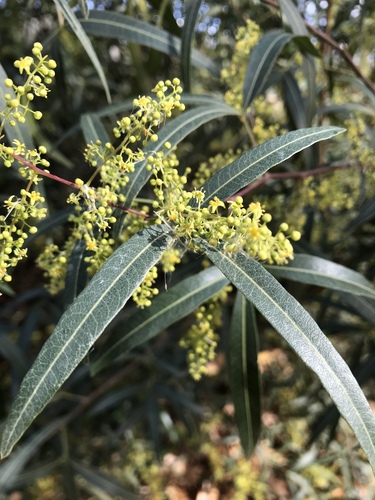
african sumac
Searsia lancea
A resilient evergreen with a graceful, weeping silhouette, the African Sumac is a cornerstone of biodiversity that provides vital shade and sustenance in arid landscapes.
Quick Identification
Size
Reaches heights of 5 to 8 metres (16–26 feet) with a canopy spread of approximately 5 metres (16 feet).
Colors
Glossy dark green foliage with a lighter underside; rough, dark brown to black fissured bark; small yellow-green flowers and grey-green berries.
Key Features
- Distinctive trifoliate leaves with three narrow, lance-shaped leaflets
- Drooping, willow-like habit with a multi-stemmed growth pattern
- Rough, deeply fissured dark bark that becomes more textured with age
- Small, flattened bunches of pea-sized fruit that turn from green to brown
When You’ll See Them
Geographic range
Where Does the african sumac Live?
Native to the Southern African interior, the African Sumac is a staple of the Highveld and Bushveld regions in South Africa, Namibia, and Botswana. It has since traveled across the Atlantic, becoming widely naturalized in the Southwestern United States and Northern Mexico, where it flourishes in the desert climates of Arizona and California. This tree is a master of adaptation, successfully bridging the gap between wild African savannas and modern suburban landscapes.
Basemap © OpenStreetMap contributors
Behavior
The African Sumac, also known as the Karee, is a remarkably resilient evergreen tree that serves as a vital hub for biodiversity. In its native Southern African habitat and its naturalized environments in North America, it is prized for its extreme drought tolerance and frost hardiness. It grows with a characteristic weeping habit, often forming a dense canopy that provides essential shade for ground-dwelling animals and cooling microclimates in arid suburban gardens.
As a non-invasive but vigorous grower, it interacts with humans primarily as an ornamental landscape feature. However, its ecological behavior is that of a 'service provider.' It does not aggressively compete with other plants but instead anchors the soil and provides a year-round structure for nesting. While the tree itself is stationary, its life cycle is dictated by the seasons; it blooms with tiny, nectar-rich flowers that attract a frenzy of insect life, followed by the production of small berries that serve as a critical food source during drier months.
EverydayEarth exclusive
Camera Tips
To capture the wildlife attracted to an African Sumac, position your camera about 5 to 7 feet high on a neighboring structure or a sturdy branch, angled downward toward a fork in the tree or a cluster of berries. This tree is a magnet for songbirds, and capturing them requires a fast shutter speed to freeze their movement amidst the thin, swaying leaves. If your camera allows, use a 'zone timing' setting to trigger during early morning hours when bird activity is at its peak.
Because the African Sumac has very fine, willow-like foliage, wind can often cause false triggers on PIR (Passive Infrared) sensors. To mitigate this, reduce your camera's sensitivity slightly or ensure the focal area is a solid branch or the main trunk rather than the wispy ends of the limbs. If you are targeting the pollinators that visit the yellow-green flowers, a macro lens attachment or a camera with a short focal distance is essential, as these flowers are quite small.
Don't forget the base of the tree! Many small mammals and ground birds visit the African Sumac to forage for fallen berries or to seek shelter in its deep shade. Placing a trail camera 12 inches off the ground, pointed toward the trunk, can reveal nocturnal visitors like porcupines in Africa or javelinas and foxes in North America. During the fruiting season (usually late summer to autumn), activity increases significantly, making it the ideal time for high-frequency recording.
Frequently Asked Questions
Record african sumac at your habitat
Connect a camera to start building your own species record — AI identifies every visitor automatically.