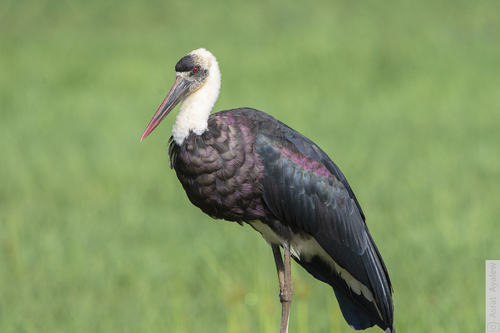
African Woolly-necked Stork
Ciconia microscelis
A striking wader with a unique 'woolly' white neck and iridescent black plumage. Once a shy wetland resident, this adaptable stork is now becoming a frequent and welcome visitor to African backyard gardens.
Quick Identification
Size
85–95 cm (33–37 in) tall; wingspan of 150–180 cm (59–71 in); weight 1.6–2.5 kg (3.5–5.5 lb)
Colors
Glossy blackish plumage with iridescent green and purple sheen; fluffy white feathers on the neck; solid black crown; white belly and undertail
Key Features
- Distinctive thick white 'woolly' feathers on the neck
- Solid black cap on the head
- Long reddish-black legs
- Deeply forked black tail mostly hidden by white coverts
When You’ll See Them
Geographic range
Where Does the African Woolly-necked Stork Live?
The African Woolly-necked Stork is native to the vast landscapes of sub-Saharan Africa. Its core range extends from Senegal in the west, across the Sahel to Ethiopia, and then southwards through East Africa into South Africa and Zimbabwe. While they are resident across much of this territory, they are particularly well-established in the wetter eastern and southern regions of the continent, where they often overlap with human settlements.
Basemap © OpenStreetMap contributors
Recorded on EverydayEarth
Behavior
The African Woolly-necked Stork is a graceful and often solitary wader, though it can be found in pairs or small family groups. Unlike many other stork species that prefer vast, open wetlands, the Woolly-neck is comfortable in more confined spaces, including forest clearings and narrow riverbanks. They are known for their slow, methodical walking pace as they hunt, often pausing for long periods to strike at prey with lightning speed.
In recent years, this species has shown remarkable adaptability to human environments. In Southern Africa particularly, they have become a common sight on suburban lawns and golf courses. While they are generally quiet birds, they are not entirely silent; during the breeding season, they engage in bill-clattering displays at their nests, which are typically large platforms of sticks built high in trees.
EverydayEarth exclusive
Camera Tips
To capture the African Woolly-necked Stork on your backyard or trail camera, the most important factor is open ground. These storks are terrestrial foragers that love to patrol short-mown grass or the muddy margins of garden ponds. Position your camera at a low angle, roughly 30 to 45 centimeters off the ground. This perspective not only captures the full height of the bird but also highlights the unique texture of their namesake neck feathers against the background.
If you have a water feature, aim your camera at the shallowest point where the bird might land to drink or hunt for frogs. They are incredibly consistent; if a stork finds your garden productive, it will likely visit at the same time every morning. Because they are large birds, ensure your camera has a wide enough field of view so you don't just get a shot of their legs—backing the camera off by 3 to 5 meters from the target area usually yields the best results.
Set your camera to take short video bursts or high-speed multi-shot photos. While they move slowly when hunting, their takeoff is sudden and powerful, and a video clip will allow you to see the beautiful iridescent sheen of their wings. Since they are strictly active during the day, you don't need to worry about infrared flash quality as much as daytime color accuracy. Avoid using artificial lures; instead, keeping a 'wild' corner of your garden or a chemical-free lawn will naturally attract the insects and amphibians they crave.
During the dry season, water is the ultimate magnet. A simple birdbath on the ground or a shallow pond will almost guarantee a visit if you live within their range. Ensure the camera is positioned with the sun behind it to avoid silhouetting the bird, as their dark plumage can easily lose detail in harsh backlight.
Similar Species
Species that look similar or are commonly confused with African Woolly-necked Stork.
Black Stork
Has a solid black neck and a bright red bill and legs, whereas the Woolly-neck has a white neck and black bill.
Marabou Stork
Much larger with a massive wedge-shaped bill and a pink, featherless head and neck compared to the Woolly-neck's feathered appearance.
Abdim's Stork
Smaller with a white lower back and a green/blue patch of skin on the face, lacking the thick white woolly neck.
Frequently Asked Questions
Record African Woolly-necked Stork at your habitat
Connect a camera to start building your own species record — AI identifies every visitor automatically.