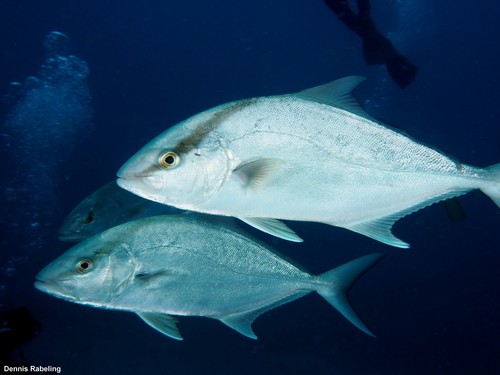
Almaco Jack
Seriola rivoliana
A sleek, deep-water powerhouse, the Almaco Jack is a prize of the open ocean. With its distinctive high-profile fin and striking 'mask,' this curious predator is a favorite for underwater explorers and offshore observers.
Quick Identification
Size
Typically 60-90 cm (24-35 in) and 10-25 kg (22-55 lbs); can reach up to 160 cm (63 in) and 60 kg (132 lbs)
Colors
Dusky-brown to olive-green upper body with silver-white underbelly; a distinctive dark diagonal bar runs from the snout through the eye to the dorsal fin
Key Features
- Deep, compressed body profile
- Long, sickle-shaped (falcate) second dorsal fin
- Dark diagonal 'raccoon stripe' through the eye
- High-arched dorsal profile compared to other amberjacks
When You’ll See Them
Geographic range
Where Does the Almaco Jack Live?
The Almaco Jack is a cosmopolitan marine species that thrives in the warm temperate and tropical waters of the world's oceans. In the Western Atlantic, they are found from the coast of Massachusetts down through the Gulf of Mexico and the Caribbean to Buenos Aires, Argentina. They also maintain a significant presence in the Indo-Pacific, ranging from South Africa and the Red Sea across to Japan, Australia, and the oceanic islands of the Eastern Pacific like the Galápagos.
Basemap © OpenStreetMap contributors
Behavior
While large adults are frequently seen patrolling solo, younger Almaco Jacks tend to be more social, forming loose schools to hunt baitfish. They are opportunistic feeders that utilize the vertical relief of underwater structures to ambush prey. Their swimming style is steady and rhythmic, but they can transition into high-speed pursuit in an instant when they detect the vibrations of a struggling fish.
EverydayEarth exclusive
Camera Tips
To capture an Almaco Jack on camera, you will need a specialized underwater setup, such as a drop-cam or a stationary housing mounted to a reef or shipwreck. Because these fish are attracted to vertical structures, the best placement is near the top of a ledge or the highest point of a wreck at depths between 30 and 100 feet. Positioning your camera to face slightly upward toward the surface can help silhouette the fish against the 'big blue,' highlighting their distinctive tall dorsal fin.
Almaco Jacks are naturally curious and are often drawn to movement and shine. You can encourage them to visit your camera by using a 'flashy' lure—a simple piece of reflective metal or a spinning blade suspended in the current a few feet from the lens. This mimics the silver scales of a baitfish and will often bring an Almaco Jack in for a close-up investigation. If your camera setup allows for it, a small bait cage containing oily fish like sardines can act as a powerful scent attractant.
Lighting is a major challenge when filming this species. At the depths where Almaco Jacks reside, red and orange light is absorbed, making the fish appear a dull blue-grey. To capture their true olive-brown and silver coloration, use a high-powered wide-angle video light. Set your camera to a fast shutter speed or a high frame rate (at least 60fps), as their movements can be incredibly quick during hunting or when they are spooked by other predators.
Similar Species
Species that look similar or are commonly confused with Almaco Jack.
Frequently Asked Questions
Record Almaco Jack at your habitat
Connect a camera to start building your own species record — AI identifies every visitor automatically.