Amazon Basin Emerald Tree Boa
Corallus batesii
Draped like living jewelry across the mossy branches of the Amazon, this boa is a master of the canopy. With its striking green scales and heat-sensing vision, it is the ultimate symbol of the tropical rainforest's mystery.
Quick Identification
Size
Typically 1.5–2.1 meters (5–7 feet) in length; neonates are much smaller at about 30–60 cm (12–24 inches).
Colors
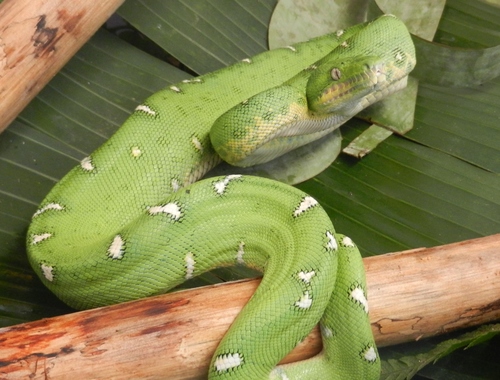
Adults are brilliant emerald green with white dorsal markings (often a continuous stripe or connected triangles). Juveniles are brick red or orange, changing to green as they mature.
Key Features
- Vibrant emerald green body with white enamel-like dorsal markings
- Deep heat-sensing pits along the labial scales (lips)
- Enormous, recurved front teeth for catching birds
- Classic looped resting posture on horizontal branches
When You’ll See Them
Geographic range
Where Does the Amazon Basin Emerald Tree Boa Live?
This magnificent boa is native to the vast tropical expanses of South America's Amazon Basin. Its range extends through Brazil, Peru, Ecuador, Colombia, and southern Venezuela, strictly following the humid lowland rainforests associated with the Amazon River drainage system. Unlike its northern cousins, this species is a specialist of the deep, moist interior of the continent's most iconic jungle.
Basemap © OpenStreetMap contributors
Behavior
The Amazon Basin Emerald Tree Boa is a highly specialized arboreal predator that spends almost its entire life in the forest canopy. They are famous for their unique resting position, where they coil their bodies over a horizontal branch with their head tucked neatly into the center of the coils. This posture provides stability and allows them to remain motionless for days at a time.
As a nocturnal species, they become active after dusk, using a combination of excellent vision and highly sensitive thermoreceptive pits to locate warm-blooded prey in total darkness. While they are solitary and slow-moving, they are capable of incredibly fast strikes when hunting or defending themselves. Although non-venomous, their bite is powerful due to their long, sharp teeth designed to penetrate thick layers of feathers or fur.
EverydayEarth exclusive
Camera Tips
Capturing the Amazon Basin Emerald Tree Boa on camera requires thinking vertically. These snakes are rarely found on the ground, so you must mount your camera at heights between 3 to 10 meters (10 to 30 feet). Focus on horizontal, moss-covered branches that are relatively clear of obstructing leaves, as these are preferred resting and hunting spots.
Because they are nocturnal, a camera with a high-quality, long-range infrared flash is essential. Standard white flash can be too startling and may wash out the snake's brilliant green color in the final image. Set your camera to a high-sensitivity PIR (passive infrared) trigger, or better yet, use a time-lapse mode if you have identified a branch where a boa is currently 'parked,' as they can remain still for several days.
Wide-angle lenses are often better in the dense canopy to capture the entire coil of the snake. Ensure your camera housing is rated for high humidity and tropical downpours; using internal desiccant packs is highly recommended to prevent lens fogging in the Amazonian heat. Positioning the camera to look slightly down on a branch will give you the best view of the white dorsal markings used for species identification.
Frequently Asked Questions
Record Amazon Basin Emerald Tree Boa at your habitat
Connect a camera to start building your own species record — AI identifies every visitor automatically.