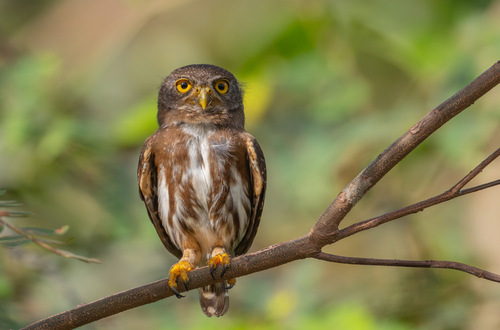
Amazonian Pygmy-Owl
Glaucidium hardyi
The Amazonian Pygmy-Owl is a pint-sized powerhouse of the rainforest canopy. Though barely larger than a sparrow, this fierce hunter dominates the tropical treetops with its sharp talons and deceptive 'false eyes' that protect it from predators.
Quick Identification
Size
Length: 14–15 cm (5.5–5.9 in); Wingspan: 28–33 cm (11–13 in); Weight: 50–65 g (1.8–2.3 oz)
Colors
Greyish-brown upperparts with fine white spotting on the crown; white underparts with rufous-brown vertical streaks; yellow iris; two black 'false eye' spots on the nape.
Key Features
- Tiny, compact build with a relatively long tail
- Fine white spots on the crown (not streaks)
- Black 'false eyes' (ocelli) on the back of the neck
- Yellow eyes and bill
- Distinctive fast, rhythmic trilling call
When You’ll See Them
Geographic range
Where Does the Amazonian Pygmy-Owl Live?
Native to the South American continent, the Amazonian Pygmy-Owl is a quintessential inhabitant of the Amazon Basin. Its core range spans across northern and central Brazil, eastern Peru, and northern Bolivia, extending upward into the Guianas, southern Venezuela, and southeastern Colombia. As a lowland specialist, it is almost exclusively found in undisturbed tropical rainforests and is rarely seen in heavily cleared or urbanized areas.
Basemap © OpenStreetMap contributors
Behavior
The Amazonian Pygmy-Owl is a diurnal and crepuscular hunter, meaning it is frequently active during the day and twilight hours. Despite its diminutive size, it is a bold predator, often sitting on high, open branches in the forest canopy to scan for prey. Because it is active when other birds are awake, it is frequently 'mobbed' by smaller songbirds like tanagers and hummingbirds who recognize it as a threat and try to drive it away.
Unlike many larger owls, this species does not have a silent flight and can be quite vocal. Its presence is most often detected by its song—a rapid series of 10-30 hollow whistles. It is generally a solitary bird, maintaining a territory in the upper layers of the rainforest. While it is not particularly shy of humans, its preference for the high canopy makes it difficult to observe without binoculars or specialized camera equipment.
EverydayEarth exclusive
Camera Tips
Capturing the Amazonian Pygmy-Owl on camera requires a specialized approach because this species spends the vast majority of its life in the high canopy. To get a clear shot, mount your AI-powered camera on a high-reaching tripod or use a secure tree mount that can be positioned on a ridge or an overlook where the camera is level with the upper tree limbs. Avoid pointing the lens directly into the bright sky to prevent silhouetting; instead, aim for a backdrop of dense foliage to help the camera's autofocus lock onto the bird.
Since these owls are active during the day, you don't need heavy infrared flash, but a fast trigger speed is essential. They are known for 'tail-flicking' and sudden darting movements when they spot an insect. Set your camera to burst mode to capture the moment of a strike. If you are using a trail camera in a backyard setting near a forest edge, look for 'song posts'—tall, dead snags that poke above the canopy line where the owl may sit to call at sunrise.
While we generally discourage baiting wild owls with food, you can use their natural curiosity to your advantage. These owls are highly territorial and will often investigate the sound of another pygmy-owl. Using a recorded audio lure (sparingly) during the first hour of light can bring them lower into the mid-story where your camera is positioned. Just ensure you are not over-using audio, as this can stress the bird.
Finally, keep an eye on the behavior of other birds in the area. If your camera's motion sensor is being triggered by a group of small, agitated birds (mobbing behavior), there is a high probability that an Amazonian Pygmy-Owl is perched nearby. Position your camera near flowering or fruiting trees that attract the small birds and insects the owl preys upon.
Similar Species
Species that look similar or are commonly confused with Amazonian Pygmy-Owl.
Frequently Asked Questions
Record Amazonian Pygmy-Owl at your habitat
Connect a camera to start building your own species record — AI identifies every visitor automatically.