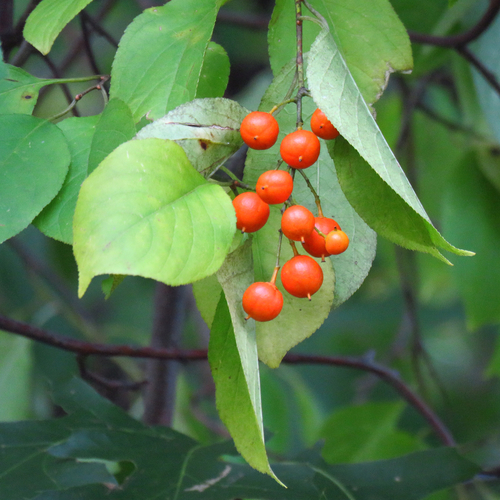
American bittersweet
Celastrus scandens
American bittersweet is a stunning native vine that brings the colors of a prairie sunset to the forest edge. Known for its brilliant scarlet berries and twining woody stems, it is a winter lifeline for songbirds and a favorite of backyard naturalists.
Quick Identification
Size
A woody vine reaching lengths of 10–30 feet (3–9 meters) with a stem diameter up to 4 inches (10 cm).
Colors
Glossy green foliage turning bright yellow in fall; orange-yellow fruit husks that burst to reveal scarlet-red berries.
Key Features
- Twining woody stems that wrap around support without tendrils
- Fruit and flowers grow in terminal clusters at the very tips of branches
- Orange husks that split into three parts to reveal fleshy red seeds
- Alternate, ovate leaves with finely serrated edges and pointed tips
When You’ll See Them
Geographic range
Where Does the American bittersweet Live?
Native to the North American continent, American bittersweet has a wide geographic footprint stretching from the central provinces of Canada down through the eastern and central United States. Its core range extends from Saskatchewan and Quebec in the north to as far south as Texas and Georgia, though it is increasingly rare in its southern and easternmost reaches. You will most likely encounter it in the Great Plains, the Midwest, and the Appalachian regions where it clings to the margins of deciduous forests.
Basemap © OpenStreetMap contributors
Behavior
American bittersweet is a vigorous, deciduous woody vine known for its twining growth habit. Unlike many vines that use tendrils or adhesive disks, this species climbs by tightly wrapping its main stem around trees, shrubs, or man-made structures. This can sometimes lead to 'girdling,' where the vine eventually chokes the host plant as it expands in diameter. It is a dioecious species, meaning individual plants are typically either male or female; only the female plants produce the iconic colorful fruit, provided a male plant is nearby for pollination.
In the wild, it plays a vital role as a late-season food source. While the berries are toxic to humans and many pets, they are a high-energy resource for birds and small mammals during the lean winter months. The vine is also a popular choice for traditional craftwork and wreaths, though enthusiasts must be careful to distinguish it from its invasive lookalike, the Oriental bittersweet, which is rapidly displacing this native species across much of its range.
EverydayEarth exclusive
Camera Tips
Capturing American bittersweet on a backyard camera is less about the plant's movement and more about the wildlife it attracts. To get the best shots, position your camera near a mature female vine during late autumn and winter. This is when the vibrant orange and red berries are most visible and act as a magnet for hungry birds like Cedar Waxwings, Northern Cardinals, and Bluebirds. Aim your camera at a sturdy horizontal branch or a fence line where the berries are densest, as birds will often land there to feed.
For the best lighting, set your camera to face north or south to avoid direct lens flare during the low winter sun. A height of 4 to 6 feet is usually ideal, depending on where the fruit clusters are located. Use a high-trigger-speed setting or 'burst mode' to catch the quick movements of birds plucking berries. Since the berries persist into the snow, this plant provides one of the best opportunities for high-contrast winter wildlife photography.
If you are interested in the growth of the vine itself, American bittersweet is an excellent subject for a time-lapse project. Set your camera to take one photo every 24 hours starting in early May. By late June, you will have a fascinating record of the vine's rapid twining motion as it searches for support and eventually blooms with its subtle, yellowish-green flowers. Ensure the camera is mounted to a very stable post that won't shift during the growing season.
Frequently Asked Questions
Record American bittersweet at your habitat
Connect a camera to start building your own species record — AI identifies every visitor automatically.