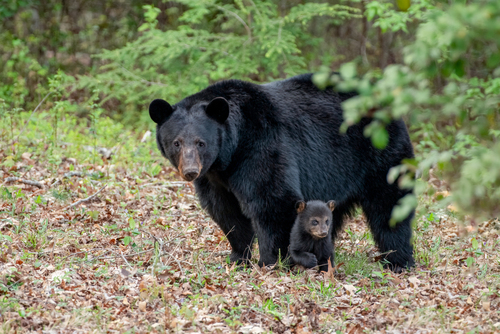
American Black Bear
Ursus americanus
The American Black Bear is a symbol of the North American wilderness, a powerful yet elusive omnivore that has mastered the art of living alongside humans. From deep mountain forests to suburban backyards, these 'ghosts of the woods' are a top prize for any wildlife photographer.
Quick Identification
Size
4 to 7 feet (1.2 to 2.1 meters) long; 90 to 550 pounds (40 to 250 kilograms)
Colors
Usually solid black with a brown muzzle, but can be cinnamon, blonde, or even white (Kermode bear) or bluish-gray (Glacier bear).
Key Features
- Straight, 'Roman' facial profile without a forehead dish
- Large, rounded ears set high on the head
- Lack of a prominent shoulder hump
- Short, curved claws specialized for climbing trees
When You’ll See Them
Geographic range
Where Does the American Black Bear Live?
Native to the North American continent, the American Black Bear is the most widely distributed bear species in the region. Its vast territory extends from the northern wilderness of Alaska and the Canadian boreal forests all the way down through the United States to the isolated mountain ranges of northern Mexico. While they were historically found across nearly the entire continent, their current core range focuses on the Pacific Northwest, the Rocky Mountains, the Great Lakes region, and the Appalachian chain.
Basemap © OpenStreetMap contributors
Behavior
American Black Bears are intelligent, curious, and primarily solitary animals, though they do not strictly defend territories and may congregate in areas with abundant food. They are incredibly agile for their size, capable of running up to 30 miles per hour and climbing large trees with ease to find food or escape danger. While they are often portrayed as aggressive, they are generally shy and prefer to avoid human contact whenever possible.
As winter approaches, black bears enter a period of light hibernation or torpor, retreating to dens in hollow logs, caves, or even excavated holes in the ground. During this time, their metabolism slows significantly, but they can be easily awakened if disturbed. In the spring and summer, much of their daily life is dedicated to 'hyperphagia'—the drive to consume as many calories as possible to build fat reserves for the next winter.
EverydayEarth exclusive
Camera Tips
Capturing an American Black Bear on camera requires heavy-duty equipment and strategic placement. Because these bears are naturally inquisitive and possess a powerful sense of smell, they will often investigate new objects in their environment. It is highly recommended to use a steel security box (often called a 'bear box') to protect your camera from being bitten or swatted. Secure the box to a sturdy, mature tree using lag bolts or heavy-duty python cables to ensure the bear doesn't knock it out of alignment or walk off with the device.
Placement should focus on 'travel corridors'—natural funnels in the landscape like dry creek beds, ridgelines, or gaps in stone walls. Look for 'bear trees' in the area, which are trees used for marking territory; these will have visible claw marks or clumps of hair caught in the bark. Mounting your camera at chest height, roughly 3 to 4 feet off the ground, provides the most flattering angle and ensures you capture the bear’s face and ears clearly. A slight downward angle can help prevent glare from the sun and capture smaller cubs that might be trailing behind their mother.
Regarding settings, utilize a high-quality video mode if your camera supports it. A 20-30 second video clip reveals much more about bear behavior and health than a single still photo. Ensure your trigger speed is set to the fastest possible interval (0.5 seconds or less) because while bears often lumber slowly, they can move through a frame surprisingly quickly. If you are using a flash, 'no-glow' or black infrared is preferred to prevent spooking the animal or drawing unwanted human attention to your setup. Lastly, avoid using food baits which can habituate bears to human presence; instead, rely on natural lures like a nearby berry patch or a known watering hole.
Frequently Asked Questions
Record American Black Bear at your habitat
Connect a camera to start building your own species record — AI identifies every visitor automatically.