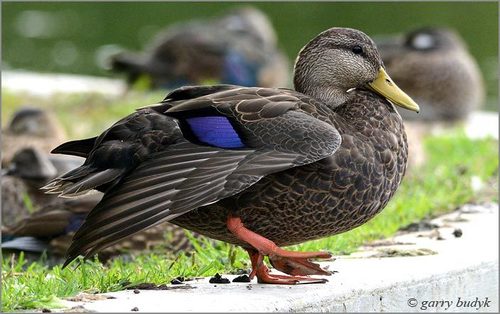
American Black Duck
Anas rubripes
The American Black Duck is the 'shadow' of the marsh—a dark, elegant, and notoriously shy dabbler that haunts the quiet corners of eastern wetlands. With its deep chocolate plumage and flash of violet wings, it is a prized capture for any backyard wildlife enthusiast.
Quick Identification
Size
Length 54–59 cm (21–23 in), wingspan 88–95 cm (35–37 in), weight 720–1,640 g (1.6–3.6 lb)
Colors
Very dark chocolate-brown body plumage with a contrasting pale grayish-tan head. Speculum (wing patch) is iridescent violet-blue with no white borders. Males have bright yellow bills; females have dull olive-green bills with dark spotting.
Key Features
- Dark, sooty-brown body contrasting with a pale face
- Violet-blue wing patch lacking white edges
- Silvery-white underwings highly visible during flight
- Male has a bright yellow-to-orange bill
- Larger and darker than a female Mallard
When You’ll See Them
Geographic range
Where Does the American Black Duck Live?
The American Black Duck is a true North American native, found primarily throughout the eastern half of the continent. Its core breeding range extends from the boreal forests of Manitoba and Ontario across to the Atlantic provinces and down into the Great Lakes and northeastern United States. As a hardy partial migrant, many spend their winters along the Atlantic coast from the Maritime Provinces all the way down to the Carolinas, where they thrive in brackish estuaries and salt marshes.
Basemap © OpenStreetMap contributors
Behavior
The American Black Duck is often described as the most wary and wild of all dabbling ducks. Unlike their cousins, the Mallards, they are much less likely to become habituated to human presence and typically prefer quiet, secluded wetlands. They are classic dabblers, meaning they feed by tipping their tails into the air to reach submerged vegetation rather than diving deep underwater.
These ducks are highly social during the winter, often forming large flocks in coastal marshes, but they become fiercely territorial during the spring breeding season. While they can be found in urban parks with large ponds, they usually stick to the thickest vegetation near the water's edge. Their flight is fast and powerful, often springing directly from the water into the air with a loud splashing start.
EverydayEarth exclusive
Camera Tips
To capture the American Black Duck on camera, placement is everything. These ducks are incredibly wary of movement, so mount your camera on a sturdy post or tree trunk at the very edge of a pond or marsh, ideally no more than 1 to 2 feet above the water level. This low angle provides a stunning, intimate perspective of the bird as it dabbles. If you are using a trail camera with a flash, ensure it uses 'No Glow' or black IR LEDs, as these birds are easily spooked by visible red glows at night.
Target 'loafing spots'—these are usually half-submerged logs, flat rocks, or grassy hummocks where ducks climb out of the water to preen and rest. If you have a private pond, attracting them with native aquatic plantings like wild rice or pondweed is much more effective than artificial bait, which often attracts unwanted pests or less-desirable species. American Black Ducks are most active in the golden hours of dawn and dusk, so set your camera to take multi-shot bursts to catch the perfect preening pose or the moment they tip up to feed.
During the winter months, look for areas of open water that haven't frozen over. Because they are darker than most ducks, they can sometimes appear as a dark blob in bright sunlight; if your camera allows, try to position it so the sun is behind the lens. This will help highlight the subtle tan feather edges on their dark bodies and the brilliant purple of their wing patches when they stretch.
Similar Species
Species that look similar or are commonly confused with American Black Duck.
Mallard (Female)
Much lighter, mottled orange-brown body and has white borders on the blue wing patch.
Mottled Duck
Found further south; has a warmer, buff-colored head and a distinct black spot at the base of the bill.
Gadwall
Slightly smaller with a gray-brown body and a white wing patch instead of purple.
Frequently Asked Questions
Record American Black Duck at your habitat
Connect a camera to start building your own species record — AI identifies every visitor automatically.