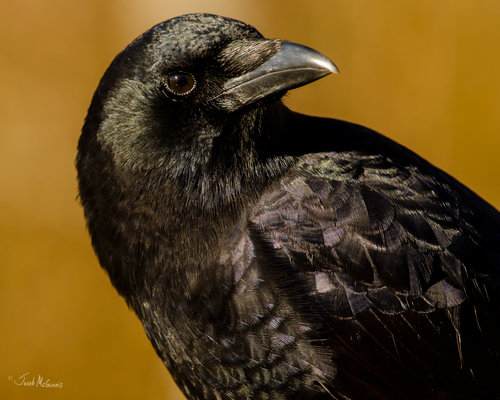
American Crow
Corvus brachyrhynchos
Brilliant, social, and remarkably adaptable, the American Crow is a highly intelligent neighbor with a complex family life and a memory for faces.
Quick Identification
Size
Length: 40–53 cm (16–21 in); Wingspan: 85–100 cm (33–39 in); Weight: 316–620 g (11–22 oz)
Colors
Uniformly black plumage with an iridescent sheen; black bill, legs, and feet. Juveniles have duller brownish feathers and blue eyes.
Key Features
- Entirely black plumage and stout black bill
- Squared-off or fan-shaped tail in flight
- Deep, harsh 'caw-caw' vocalization
- Frequent social gathering in groups or murders
When You’ll See Them
Sightings on EverydayEarth
Jul 27, 2026
Three American Crows are perched on various branches within a pine tree, positioned around a large stick nest. The birds are seen turning their heads and adjusting their weight as sunlight filters through the canopy.
Jul 20, 2026
An American Crow is perched on a branch to the left of a large raptor nest. The bird is mostly stationary, looking out over the lush, green river valley as the afternoon sun filters through the canopy.
Jul 13, 2026
An American Crow is perched on a large branch adjacent to a stick nest. It remains relatively still, occasionally turning its head to look around the surrounding woodland and the valley visible in the distance.
Jun 27, 2026
An American Crow is perched on a large tree limb, looking around and briefly investigating the bark before taking flight and moving out of the frame. The surrounding foliage is seen swaying in the wind.
Jun 22, 2026
An American Crow is perched on a branch amidst leafy foliage in the early morning. It stays mostly stationary, occasionally shifting its weight and opening its beak as if vocalizing into the misty air.
Jun 20, 2026
An American Crow is perched on a high branch in the upper left of the frame. It remains mostly still, occasionally shifting its weight and looking around the lush green valley in the evening light.
Geographic range
Where Does the American Crow Live?
The American Crow is native to the North American continent, where it maintains a massive and stable presence. Its range stretches across nearly the entire United States and much of southern and central Canada, only avoiding the most extreme arctic regions and the driest stretches of the southwestern deserts. While many populations are permanent residents, those in the northernmost reaches of Canada are partial migrants that shift southward during the harshest winter months.
Basemap © OpenStreetMap contributors
Behavior
American crows are among the most intelligent of all bird species, displaying remarkable problem-solving skills, tool use, and the ability to recognize individual human faces. They are highly social creatures that live in extended family groups, where offspring often stay with their parents for several years to help raise the next generation of chicks. Their social structure is incredibly complex, involving coordinated defense against predators and communal roosting.
In the backyard, crows are wary but curious. They spend much of their day foraging on the ground, often working in pairs or small groups where one individual acts as a sentinel, watching for danger from a high perch while others eat. They are famous for 'mobbing' larger birds of prey, such as hawks and owls, using their numbers and persistent calling to drive the intruders away from their nesting territories.
EverydayEarth exclusive
Camera Tips
Capturing American Crows on your backyard camera requires a bit of strategy because of their high intelligence and 'neophobia'—a natural fear of new things. When first placing your camera, try to camouflage the housing with natural materials like bark or dried leaves, as a shiny plastic box may cause them to avoid the area for days. Position the camera about 3 to 5 feet off the ground, preferably facing an open patch of lawn or a flat platform feeder where the birds feel safe landing with a clear view of their surroundings.
To draw them into the frame, use high-value rewards like unsalted peanuts in the shell, suet, or even small amounts of dry dog food. Crows are social, so if you can attract one, you will likely attract the whole family. Set your camera's trigger interval to be as short as possible; crows are remarkably fast and often hop out of the frame quickly. If your AI camera has a 'burst' or 'multi-shot' mode, enable it to capture the fascinating social dynamics and head-tilting behavior that crows display while investigating food.
Lighting is the biggest challenge when photographing an all-black bird. To prevent the crow from looking like a featureless silhouette, place your camera with the sun at its back so the light hits the feathers directly. This reveals the beautiful violet and green iridescence that is often invisible in shade. Early morning and late afternoon provide the best directional light. During winter, look for large communal movements; placing a camera near a known flight path during the 'golden hour' can result in stunning silhouettes against the sunset.
Similar Species
Species that look similar or are commonly confused with American Crow.
Frequently Asked Questions
Record American Crow at your habitat
Connect a camera to start building your own species record — AI identifies every visitor automatically.