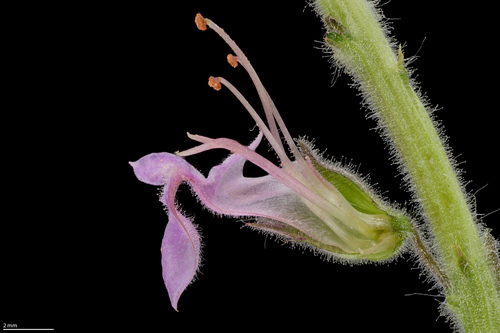
American germander
Teucrium canadense
A resilient native wildflower that turns damp garden corners into a bustling hub for butterflies and bees. With its striking lavender spikes and unique 'lip-less' blooms, American germander is a master of North American wetlands.
Quick Identification
Size
Grows 1 to 3 feet (30–90 cm) tall with a spread that can reach 2 feet via rhizomes.
Colors
Pale lavender to pinkish-purple flowers, often with white centers and purple spots; stems are grayish-green.
Key Features
- Square, hairy stems typical of the mint family
- Terminal flower spikes with lipped blooms lacking an upper lip
- Opposite, lance-shaped leaves with serrated edges
- Long protruding stamens that curve upward from the flower
When You’ll See Them
Geographic range
Where Does the American germander Live?
American germander is a widespread native of North America, flourishing across nearly the entire contiguous United States and extending into the southern provinces of Canada from British Columbia to Quebec. It is particularly prevalent in the eastern and central regions of the continent, where moist prairies and river valleys provide the damp conditions it craves. While primarily a North American staple, it can also be found in parts of Mexico and has been introduced to various temperate regions globally as an ornamental or accidental stowaway.
Basemap © OpenStreetMap contributors
Behavior
American germander is a hardy, colony-forming perennial that plays a vital role in the late summer ecosystem. Unlike many other members of the mint family, its flowers lack a distinct upper lip, which gives the flower spike a unique, tiered appearance. It is a social plant in the sense that it spreads aggressively through underground rhizomes, often forming dense patches that provide excellent cover for ground-dwelling insects and small amphibians.
For the backyard observer, this species is most notable for its interactions with pollinators. It is a primary nectar source for long-tongued bees, such as bumblebees and honeybees, as well as various butterfly species. While it lacks the strong minty scent common to its cousins, it is a resilient survivor, often thriving in damp soil where other decorative plants might struggle with root rot.
EverydayEarth exclusive
Camera Tips
To capture the beauty of American germander, place your camera on a low tripod or stake roughly 12 to 24 inches off the ground. Because this plant attracts a high volume of insect life, using a camera with a dedicated macro mode or a high-speed trigger is essential. Focus your lens on the middle of the flower spike, as this is where bees and butterflies are most likely to land and linger while foraging.
Since American germander often grows in damp, shaded areas, lighting can be a challenge. Try to position your camera so it faces east or west to catch the 'golden hour' light, which beautifully highlights the translucent lavender petals. If your camera allows for video, set it to 60fps; the swaying of the tall spikes in a light breeze creates a hypnotic, cinematic effect that is perfect for capturing the 'wild' feel of a backyard meadow.
For those interested in the wildlife visiting the plant, use a time-lapse setting during the peak morning hours (8 AM to 11 AM). This is when nectar production is often at its highest and pollinator traffic is most frequent. Ensure your camera is well-secured, as the rhizomatous nature of the plant means it often grows in soft, muddy soil where stakes can easily shift. If you are using an AI-powered camera, set the sensitivity to 'Small Animals' to ensure you don't miss the fast-moving bees and hummingbirds that frequent these blooms.
Frequently Asked Questions
Record American germander at your habitat
Connect a camera to start building your own species record — AI identifies every visitor automatically.