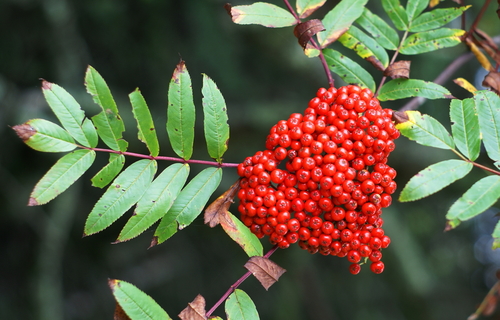
American mountain ash
Sorbus americana
A Northern landscape icon that provides a critical winter lifeline for wildlife. With its snowy spring blooms and fiery autumn berries, the American mountain ash is a backyard bird-watching powerhouse.
Quick Identification
Size
10-30 feet (3-9 meters) tall with a spread of 15-25 feet (4.5-7.5 meters)
Colors
Dark green foliage turning yellow to reddish-purple in fall; creamy white flower clusters; brilliant red-orange fruit
Key Features
- Pinnately compound leaves with 11-17 narrow, serrated leaflets
- Large, flat-topped clusters (corymbs) of tiny white flowers
- Dense bunches of bright red-orange berries (pomes) that persist into winter
- Smooth, grayish-brown bark with horizontal lenticels
When You’ll See Them
Geographic range
Where Does the American mountain ash Live?
The American mountain ash is a quintessential native of the cool, moist climates found across eastern North America. Its primary range begins in the north throughout Newfoundland and Quebec, stretching westward toward Ontario and the Great Lakes region. To the south, it follows the high-elevation corridors of the Appalachian Mountains through New England and down into the peaks of North Carolina, Tennessee, and northern Georgia, where it thrives in the thin, acidic soils of rocky ridges. While it is most abundant in Canada and the northeastern United States, it has been introduced as an ornamental landscape tree in temperate regions across the globe.
Basemap © OpenStreetMap contributors
Behavior
In the wild, it often grows as a solitary specimen or in small groups, frequently found on rocky slopes where other trees struggle. In suburban settings, it is a popular ornamental choice due to its manageable size and multi-seasonal interest. While it is not an 'active' participant in human interaction, it is highly sensitive to environmental stress, particularly heat and drought, making it a 'sentinel' species for cooling mountain climates.
EverydayEarth exclusive
Camera Tips
To capture the best wildlife action on your American mountain ash, position your camera to focus on the berry clusters in the mid-to-upper canopy. This tree is a magnet for 'irruptive' winter birds like Cedar Waxwings, Pine Grosbeaks, and American Robins. Since these birds often feed in large, frantic groups, use a high-speed burst mode or a high-frame-rate video setting to catch the movement without blur. Aim the camera north or south to avoid the harsh backlighting of the winter sun, which can wash out the brilliant red of the berries.
Because the American mountain ash fruit (pomes) often stays on the branches after the leaves have fallen, early winter is the prime time for photography. Mount your camera on a nearby sturdy branch or a specialized pole about 10-15 feet high for an eye-level view of the feeding birds. If your camera has AI-detection, set it to 'Bird' mode, but be aware that heavy clusters of berries moving in the wind can sometimes trigger motion sensors; adjust your sensitivity settings to 'Medium' to avoid hundreds of empty clips.
Don't forget the base of the tree! In more rural or forested areas, fallen fermented berries attract ground-dwellers. Place a secondary camera approximately 2 feet off the ground, angled toward the trunk base. This is an excellent way to capture sightings of Black Bears, Raccoons, or even Ruffed Grouse who visit the tree to scavenge the dropped fruit during the late autumn months.
Similar Species
Species that look similar or are commonly confused with American mountain ash.
Frequently Asked Questions
Record American mountain ash at your habitat
Connect a camera to start building your own species record — AI identifies every visitor automatically.