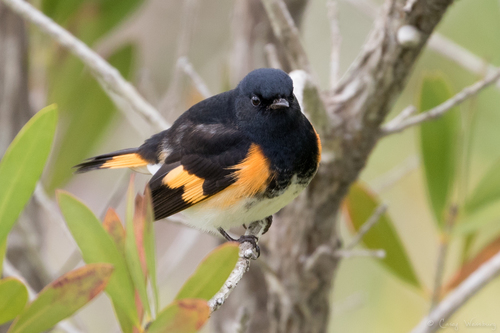
American Redstart
Setophaga ruticilla
Meet the 'Halloween Warbler,' a high-energy acrobat that uses its fiery plumage to trick insects into the open. Watch for their signature tail-fanning displays in your backyard during spring and fall migration.
Quick Identification
Size
Length: 11–13 cm (4.3–5.1 in) | Wingspan: 16–19 cm (6.3–7.5 in) | Weight: 6–10 g (0.2–0.4 oz)
Colors
Adult males are jet black with vivid orange patches on the wings, tail, and sides; females and immature males are charcoal grey with yellow or golden-yellow patches.
Key Features
- Bright orange or yellow 'flash' patches on wings and tail
- Constantly fans tail and droops wings to startle insects
- Small, flat bill with prominent rictal bristles (whiskers) at the base
- Hyperactive, butterfly-like flight pattern
When You’ll See Them
Geographic range
Where Does the American Redstart Live?
Native to the Americas, the American Redstart boasts one of the most expansive breeding ranges of any New World warbler, stretching from the boreal forests of Canada across the northern and eastern United States. As a migratory species, they leave their northern homes in late summer to spend the winter in the tropical climates of southern Mexico, Central America, the Caribbean, and northern South America. They are frequently spotted in suburban gardens and parks during their spring and fall journeys as they stop to refuel.
Basemap © OpenStreetMap contributors
Behavior
The American Redstart is often called the 'Halloween Warbler' due to the male's striking black and orange plumage. They are incredibly high-energy birds, rarely staying still for more than a few seconds. Their most distinctive behavior is their foraging technique: they fan their tails and flick their wings to reveal bright patches of color, which startles hidden insects into flight so the bird can snatch them out of the air.
While they are primarily solitary during the winter, they are fiercely territorial on their breeding grounds. They are socially monogamous but frequently engage in extra-pair copulations. For backyard observers, they are less likely to visit a traditional seed feeder and are much more likely to be seen darting through the canopy or visiting a water feature to bathe.
EverydayEarth exclusive
Camera Tips
To capture an American Redstart on camera, you must focus on water rather than food. Because they are strict insectivores, they won't visit seed or suet stations. A birdbath with a dripper or a small recirculating fountain is the ultimate lure for this species. Place your AI camera about 3 to 5 feet away from the water source, ideally at eye level with a nearby 'staging' branch where the bird might land before taking a dip.
Speed is your biggest challenge with Redstarts. They are fast-moving 'flit-and-dart' foragers. If your camera allows for manual settings, use a fast shutter speed (at least 1/1000s) or a high-frame-rate video mode to prevent motion blur. Ensure the area is well-lit, as their dark plumage can easily lose detail in deep shade. Early morning light provides the best color accuracy for those brilliant orange wing patches.
During peak migration in May and September, position your camera near native shrubs like serviceberry or dogwood. Redstarts are attracted to the insects found on these plants and will occasionally snack on the berries. If you are using a trail camera, look for 'edges'—the place where a lawn meets a wooded area—as this is their favorite hunting ground.
Similar Species
Species that look similar or are commonly confused with American Redstart.
Frequently Asked Questions
Record American Redstart at your habitat
Connect a camera to start building your own species record — AI identifies every visitor automatically.