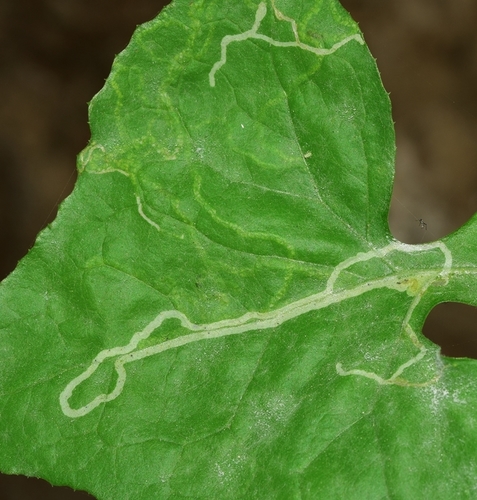
American Serpentine Leaf Miner
Liriomyza trifolii
A master of miniature engineering, the American Serpentine Leaf Miner leaves an unmistakable signature of winding white trails across the leaves of your garden. Though tiny, these flies are fascinating examples of how insects adapt to live and feed inside their environment.
Quick Identification
Size
Adults are 1-2 mm (0.04-0.08 inches) in length; wingspan is approximately 1.3-2.3 mm.
Colors
Bright yellow head and underbelly with a dark grey to black thorax; features a prominent yellow spot on the scutellum (the back plate).
Key Features
- Distinctive yellow spot on the black scutellum
- Larvae create winding white 'serpentine' trails in leaves
- Tiny 2mm body with large reddish-brown eyes
- Adults leave small circular puncture marks on leaf surfaces
When You’ll See Them
Geographic range
Where Does the American Serpentine Leaf Miner Live?
Originally native to the warmer regions of the Western Hemisphere, specifically the southeastern United States, Central America, and the Caribbean, the American Serpentine Leaf Miner has become a global traveler. It is now widely established across North America, from southern Canada down through the United States and Mexico, and has successfully invaded parts of Europe, Africa, and Asia through the trade of ornamental plants. In these new environments, it thrives in both temperate and tropical climates, particularly where human agriculture provides a steady supply of host plants like tomatoes, celery, and chrysanthemums.
Basemap © OpenStreetMap contributors
Behavior
The American Serpentine Leaf Miner is a highly specialized insect that spends most of its life cycle hidden within the very plants it feeds on. Adult females use their sharp ovipositors to puncture the upper surface of leaves, creating small holes to feed on plant sap and to deposit their eggs. These punctures often appear as white stippling on the foliage, providing the first visual cue of their presence in a backyard or garden.
Once the larvae hatch, they begin their namesake behavior: mining. They tunnel through the mesophyll layer of the leaf, staying protected between the upper and lower epidermis. As the larva grows, its tunnel widens, creating an ever-expanding, winding white trail. When ready to pupate, the larva cuts a small slit in the leaf and drops to the soil, or occasionally pupates on the leaf surface, eventually emerging as a tiny, fast-moving fly ready to start the cycle anew.
EverydayEarth exclusive
Camera Tips
Capturing the American Serpentine Leaf Miner on camera requires a shift from traditional trail camera setups to specialized macro photography or high-resolution close-up monitoring. Because these flies are only about 2mm long, standard wide-angle backyard cameras will likely miss them. To see the adults, position a camera with a macro lens or a dedicated 'insect mode' near known host plants like tomatoes, celery, or marigolds. Focus your lens on the upper surface of the leaves where adults tend to land and feed during the warmest parts of the day.
If you are using an AI-powered camera to identify the species, the 'mines' or trails in the leaves are often your best diagnostic tool rather than the fly itself. Set your camera on a tripod to maintain a steady, close-up frame of a leaf with active mines. Use a high shutter speed (at least 1/500s) if you hope to freeze the adult fly in motion, as they are incredibly fast and erratic fliers. Bright, indirect sunlight is the best lighting condition, as it illuminates the translucent 'mines' without creating harsh glares on the leaf surface.
Consider using a yellow sticky trap placed within the camera's field of view as a lure; these flies are notoriously attracted to the color yellow. By positioning your camera to monitor the trap, you can get clear, still images of the adults for identification. Ensure your camera is set to a 'time-lapse' or 'burst' mode to increase the chances of catching an adult landing. For the best results, monitor your garden in late spring when the first generation of adults emerges and begins laying eggs on fresh foliage.
Similar Species
Species that look similar or are commonly confused with American Serpentine Leaf Miner.
Frequently Asked Questions
Record American Serpentine Leaf Miner at your habitat
Connect a camera to start building your own species record — AI identifies every visitor automatically.