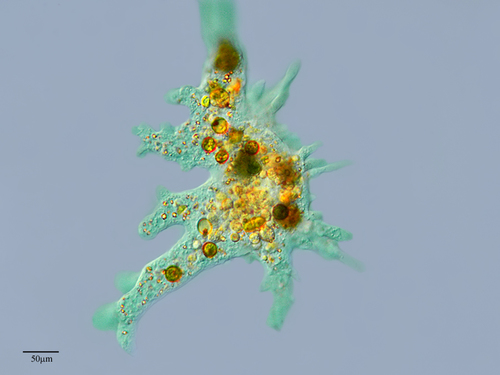
Amoeba proteus
Amoeba proteus
The shapeshifting giant of the microscopic world, Amoeba proteus brings the drama of the jungle to a single drop of pond water. This translucent predator is proof that you don't need a spine to be a master hunter.
Quick Identification
Size
250 to 750 micrometers (0.01 to 0.03 inches) in length
Colors
Translucent or greyish-white; often appears to have dark or colored granules inside from digested food
Key Features
- Extends thick, blunt pseudopodia for movement
- Constantly changing body shape
- Single large, disk-shaped nucleus visible under magnification
- Contractile vacuole that pulses to expel water
When You’ll See Them
Geographic range
Where Does the Amoeba proteus Live?
The Amoeba proteus is a cosmopolitan species found in freshwater ecosystems across every continent except Antarctica. It is most frequently documented in the temperate regions of North America, Europe, and Asia, where it thrives in the oxygen-rich shallows of permanent ponds. Because they can survive in a wide variety of freshwater conditions, they are also common inhabitants of backyard water features and garden birdbaths.
Basemap © OpenStreetMap contributors
Behavior
Amoeba proteus is a fascinating, single-celled predator that moves with a unique crawling motion known as amoeboid movement. It extends part of its body forward into a "false foot" or pseudopodium, and then flows the rest of its cellular contents into that space. This slow, deliberate prowling allows it to navigate the microscopic landscape of pond bottoms and submerged plants in search of prey.
Despite lacking a brain or nervous system, this species exhibits complex hunting behaviors. When it senses a food source like a smaller protozoan or a piece of organic debris, it uses its pseudopodia to surround the object entirely, a process called phagocytosis. This creates a food vacuole where the prey is slowly digested. They are generally solitary and spend their entire lives reacting to chemical and light stimuli in their aquatic environment.
EverydayEarth exclusive
Camera Tips
Observing Amoeba proteus requires a specialized setup compared to traditional backyard wildlife. To "capture" this species on camera, you will need a digital microscope or a smartphone with a high-power macro lens attachment (at least 100x magnification). Collect samples of water from the bottom of a pond, specifically targeting the "brown film" found on submerged leaves or rocks, as this is where amoebas concentrate to feed.
Once you have your sample on a glass slide, use a time-lapse setting on your camera. Because Amoeba proteus moves slowly (about 1 micron per second), a 30-minute recording compressed into a 30-second video will dramatically reveal its shapeshifting movement and hunting strategy. For the best visual quality, use a "darkfield" lighting technique, which makes the translucent body of the amoeba glow against a dark background, highlighting its internal organelles.
Avoid using high-intensity lights for long periods, as the heat can evaporate the water on your slide or kill the specimen. Using a "well slide" (a slide with a small depression) allows the amoeba more room to move naturally while you film. Look for specimens in the early morning when pond water is typically more still and the microscopic life hasn't been disturbed by larger aquatic animals.
Frequently Asked Questions
Record Amoeba proteus at your habitat
Connect a camera to start building your own species record — AI identifies every visitor automatically.