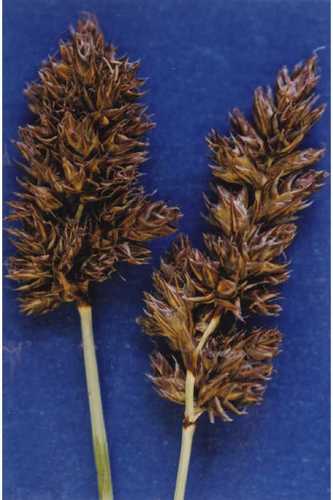
Analogue Sedge
Carex simulata
The unsung hero of the western wetlands, Analogue Sedge forms lush, golden-brown carpets across montane fens. This hardy perennial is more than just a grass-lookalike; it's a vital stabilizer for our most precious water sources.
Quick Identification
Size
Stems reaching 30 to 90 cm (12 to 35 inches) in height; leaves narrow, roughly 2–5 mm wide.
Colors
Bright to dark green foliage; flower spikes transition from green to a glossy reddish-brown or dark chocolate brown.
Key Features
- Triangular stems typical of the Cyperaceae family
- Extensive creeping rhizomes that form dense, sod-like mats
- Small, egg-shaped flower spikes clustered at the top of the stem
- Dioecious nature, where male and female flowers usually grow on separate plants
When You’ll See Them
Geographic range
Where Does the Analogue Sedge Live?
The Analogue Sedge is a quintessential mountain-west species native to North America. Its range spans from the southern provinces of Canada, including British Columbia and Saskatchewan, down through the Western United States into the high-altitude regions of New Mexico and Arizona. It is particularly prevalent in the Great Basin and the Rocky Mountain corridor, where it thrives in the unique, alkaline conditions of montane wetlands.
Basemap © OpenStreetMap contributors
Behavior
Analogue Sedge is a hardy perennial that functions as a structural anchor in wetland ecosystems. Rather than moving, its 'behavior' is defined by its aggressive rhizomatous growth, which allows it to creep across saturated soils and create dense monocultures. These mats are incredibly tough, often providing the primary ground cover in fragile peatlands and fens where other plants would drown.
In the backyard or wild habitat context, this sedge acts as a sanctuary. Its dense growth provides essential humidity and protection for micro-fauna. While it doesn't interact with humans directly, it is a favorite for restoration projects because it is excellent at filtering water and preventing soil erosion along stream banks and pond edges.
EverydayEarth exclusive
Camera Tips
To capture the beauty of Analogue Sedge, position your camera at a low 'frog's-eye' level. Because this plant lives in wet environments, use a tripod with spiked feet or a ground mount that can handle mud. Aim the lens across the top of the sedge meadow during the 'golden hour'—the low-angle sunlight will catch the glossy, dark brown seed heads (perigynia), making them pop against the green foliage.
Since sedges themselves are stationary, they make excellent 'stages' for animal activity. Place your camera near a patch of Analogue Sedge at the edge of a water source. This species is a magnet for dragonflies, damselflies, and small frogs. Set your camera to a 'High Sensitivity' motion trigger or use a time-lapse mode (one frame every 30-60 seconds) to capture the sedge swaying in the wind and the subtle arrival of wetland visitors.
For those interested in the plant's life cycle, focus on the flowering period between June and August. Macro lens attachments can reveal the intricate scales of the spikes. If you are using an AI-powered camera, ensure the focal point is locked on the spikes rather than the blades, as the thin leaves can sometimes cause the autofocus to hunt in breezy conditions.
Frequently Asked Questions
Record Analogue Sedge at your habitat
Connect a camera to start building your own species record — AI identifies every visitor automatically.