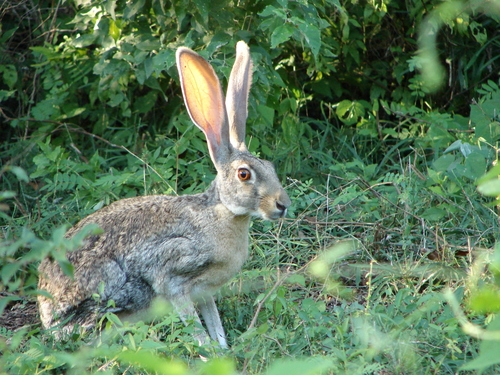
Antelope Jackrabbit
Lepus alleni
Often called the 'handsomest' of North American hares, the Antelope Jackrabbit is a desert icon with ears that defy belief. This speedy survivor is a master of the Sonoran Desert, using its unique white flanks to communicate and its massive ears to keep cool.
Quick Identification
Size
Total length of 52–58 cm (20–23 in); weight ranging from 3 to 5 kg (6.6 to 11 lbs); ears can reach 17 cm (6.7 in)
Colors
Sandy-buff upperparts with black ticking; stark white flanks and belly; ears are pale gray with white fringes
Key Features
- Extraordinarily large ears with white margins and no black tips
- Brilliant white flanks that can be pulled up to flash white signals
- Long, powerful hind legs adapted for high-speed desert running
- Pale orange or buff-colored chest and throat
When You’ll See Them
Geographic range
Where Does the Antelope Jackrabbit Live?
Native to the North American continent, the Antelope Jackrabbit is a highly specialized resident of the Sonoran Desert. Its geographic footprint is relatively small, concentrated primarily in southern Arizona within the United States and extending south through the Mexican states of Sonora, Sinaloa, and northern Nayarit. Unlike its more widespread cousins, this species is perfectly adapted to the specific heat and vegetation of the southwestern borderlands, rarely venturing far from this arid core.
Basemap © OpenStreetMap contributors
Behavior
The Antelope Jackrabbit is a master of desert survival, known for its incredible ability to regulate body temperature through its oversized ears. These ears act as biological radiators, filled with a network of blood vessels that dissipate heat into the air, allowing the hare to remain cool even in the scorching Arizona sun. Unlike many other desert mammals that retreat underground, this species stays above ground, often resting in shallow depressions called 'forms' scraped into the shade of mesquite or creosote bushes.
Socially, they are generally solitary but may gather in small groups where food is abundant. One of their most fascinating behaviors is the 'flashing' of their white flanks. When a predator or threat is detected, the jackrabbit can shift its skin to reveal more of the white fur on its sides, which acts as a signal to the predator that it has been spotted, or perhaps as a distraction during a high-speed chase. They are incredibly fast, capable of reaching speeds up to 45 mph in a zig-zag pattern.
EverydayEarth exclusive
Camera Tips
To capture the Antelope Jackrabbit on your trail camera, placement is everything. These hares travel along established 'game trails' through the desert scrub. Look for narrow, worn paths that lead between mesquite thickets or toward cactus patches. Mount your camera low—about 12 to 18 inches off the ground—and angle it slightly upward to capture the full scale of their massive ears. Because they are crepuscular, ensure your camera has a high-quality infrared flash for clear night and twilight shots without spooking them.
Water is a massive draw in the desert. If you have a backyard birdbath or a small drip system, aim your camera there. Antelope Jackrabbits will frequently visit water sources during the hottest months. In the absence of standing water, look for 'nibbled' prickly pear pads. If you see fresh bite marks on a cactus, it's a prime spot for a camera, as they will return to the same plant for hydration multiple times. During the monsoon season, they become more active during the day, so check your settings to ensure your trigger speed is fast enough to catch them mid-bound.
Be mindful of the desert sun; avoid pointing your camera directly east or west to prevent lens flare during their peak activity hours at dawn and dusk. Using a 'burst mode' or a short video setting is highly recommended. These hares move with sudden, jerky movements, and a single photo might only catch a blur of white fur. A 10-second video clip often provides the best look at their unique 'flashing' behavior or the way they rotate their ears independently to scan for predators.
Similar Species
Species that look similar or are commonly confused with Antelope Jackrabbit.
Frequently Asked Questions
Record Antelope Jackrabbit at your habitat
Connect a camera to start building your own species record — AI identifies every visitor automatically.