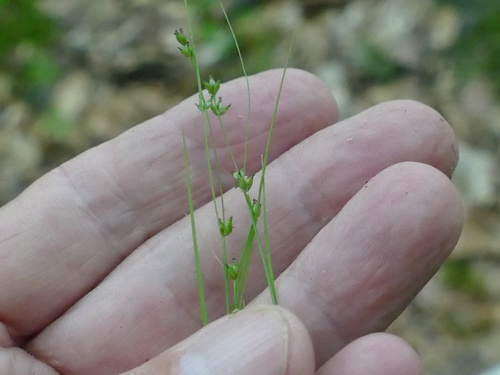
Appalachian sedge
Carex appalachica
A graceful, fountain-like sedge that creates a soft emerald carpet across the Appalachian floor. Its fine, hair-like leaves and hardy nature make it a favorite for woodland wildlife and shade-loving gardeners alike.
Quick Identification
Size
Leaves reach 20–50 cm (8–20 inches) in length; flowering culms stand 20–60 cm (8–24 inches) tall
Colors
Bright emerald green foliage; straw-colored to light brown seed heads in summer
Key Features
- Extremely narrow, hair-like leaves (under 1.5mm wide)
- Densely tufted, 'fountain-like' growth habit
- Arching or weeping foliage that often flops gracefully to the ground
- Star-shaped flower clusters (spikes) appearing in late spring
When You’ll See Them
Geographic range
Where Does the Appalachian sedge Live?
The Appalachian sedge is a signature species of the temperate eastern forests of North America. Its range extends from the Canadian provinces of Ontario and Quebec southward through the Northeastern United States and the Great Lakes region. In the southern extent of its range, it becomes a high-altitude specialist, found primarily along the ridges and cool slopes of the Appalachian Mountains in states like North Carolina, Tennessee, and Georgia.
Basemap © OpenStreetMap contributors
Behavior
Appalachian sedge is a perennial, clump-forming plant that brings a soft, misty texture to the forest floor. Unlike many aggressive grasses, it grows in distinct, tidy tufts that do not spread via runners, instead slowly expanding its central 'fountain' of foliage over several years. Its most notable physical 'behavior' is its weeping habit; as the fine leaves grow longer, they arch toward the ground, creating a lush, mounded appearance that persists throughout the growing season.
In the wild, this sedge plays a quiet but vital role in the ecosystem. It provides essential ground cover in dry, shaded environments where other plants struggle to grow, protecting the soil from erosion and providing a micro-habitat for beneficial insects. While it is stationary, it is highly responsive to the light, leaning its fine-textured culms toward gaps in the forest canopy to maximize photosynthesis.
EverydayEarth exclusive
Camera Tips
To capture the delicate beauty of Appalachian sedge on your trail camera, placement is everything. Position your camera on a low mount or even directly on the ground, angled slightly upward. This 'worm's eye view' emphasizes the arching, fountain-like structure of the leaves. Because the leaves are so fine—often less than a millimeter wide—use a camera with high resolution (4K or 30MP+) to ensure the texture doesn't appear as a green blur.
While the plant doesn't move, it is a hub for small-scale wildlife action. Set your camera to a time-lapse mode during the day to capture the visiting pollinators, such as the Little Wood Satyr butterfly, which uses sedges as a host plant. If you are using an AI-powered camera, the 'motion trigger' might not be tripped by the plant itself unless there is a stiff breeze, so a higher sensitivity setting is recommended if you want to capture the graceful movement of the foliage in the wind.
Lighting is your best friend when documenting this species. The fine leaves look spectacular when 'backlit' by the rising or setting sun, which makes the entire clump appear to glow. Position your camera facing West in the morning or East in the evening to catch this effect. In the winter, keep the camera active; the semi-evergreen foliage provides a beautiful contrast against the snow, and you are likely to capture birds like juncos or sparrows foraging for seeds hidden within the dried tufts.
Frequently Asked Questions
Record Appalachian sedge at your habitat
Connect a camera to start building your own species record — AI identifies every visitor automatically.