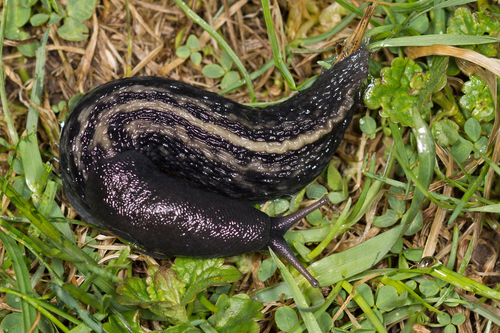
Ash-black Slug
Limax cinereoniger
Meet the undisputed heavyweight champion of the mollusk world. The Ash-black Slug is a gentle, forest-dwelling giant that can grow longer than a human hand.
Quick Identification
Size
A massive species reaching 20-30 cm (8-12 inches) in length; weighs up to 30-40g (1-1.4 oz).
Colors
Typically uniform ash-gray to jet black, though some juveniles are brownish; the sole of the foot is uniquely divided into three longitudinal bands (white center with dark gray outer edges).
Key Features
- World's largest land slug species
- Prominent keel running down the back half of the body
- Sole of the foot has a distinctive pale central stripe flanked by dark bands
- Coarsely granulated skin texture
When You’ll See Them
Geographic range
Where Does the Ash-black Slug Live?
Native to the continent of Europe, the Ash-black Slug is a classic inhabitant of ancient, undisturbed landscapes. Its core range stretches from the British Isles across Central Europe to the Ural Mountains in Russia, and as far north as southern Scandinavia. While it is widely distributed, its presence is often used by ecologists as an indicator species for high-quality, long-standing woodland habitats that have remained relatively untouched by modern agriculture.
Basemap © OpenStreetMap contributors
Behavior
The Ash-black Slug is a deliberate, slow-moving giant that acts as a vital decomposer in its ecosystem. Unlike many smaller garden slugs that are viewed as pests, this species is almost exclusively a forest dweller. It is highly nocturnal, emerging only under the cover of darkness or during extremely humid, rainy days to graze on the forest floor. Because of its large size, it requires high humidity levels to prevent desiccation, often spending its daylight hours tucked deep inside rotting logs or under heavy leaf litter.
Interestingly, these slugs are surprisingly long-lived for mollusks, with some individuals reaching up to five years of age. Their social interactions are limited primarily to complex mating rituals. While they don't suspend themselves from slime threads quite as dramatically as their cousins, the Leopard Slugs, they still engage in a circling 'dance' that can last for hours. They are generally solitary and pose no threat to humans, though they should be handled with care to avoid damaging their sensitive skin and mucus layer.
EverydayEarth exclusive
Camera Tips
Capturing the Ash-black Slug on camera requires a shift in perspective. Because they are ground-dwelling and move slowly, place your camera as low as possible—ideally directly on the forest floor or mounted on a small tripod just inches above the ground. Use a macro lens setting if your camera supports it, as the fine details of their granulated skin and the unique 'keel' on their back are what make for a stunning photo. If you are using a trail camera, ensure it has a short minimum focal distance, otherwise, the slug will appear as a blurry dark mass.
Since these giants are strictly nocturnal, IR (infrared) night vision is essential. However, because slugs are highly reflective due to their mucus coating, standard IR flashes can sometimes 'white out' the subject. If possible, position your camera at a 45-degree angle to the slug's expected path rather than head-on to reduce glare. Setting your camera to 'Time-lapse' mode with intervals of 10-30 seconds is often more effective than motion-triggering, as a slug's slow movement may not always trip a standard PIR sensor.
Timing is everything with this species. The best opportunities for footage occur during or immediately after a heavy rainstorm when the humidity is near 100%. Look for 'slime trails' on large, rotting logs or at the base of old-growth trees. You can encourage a visit by placing a damp piece of untreated wood or a few slices of fresh mushrooms in front of your camera lens. Be patient; a single frame-worthy crossing can take thirty minutes or more!
Similar Species
Species that look similar or are commonly confused with Ash-black Slug.
Frequently Asked Questions
Record Ash-black Slug at your habitat
Connect a camera to start building your own species record — AI identifies every visitor automatically.