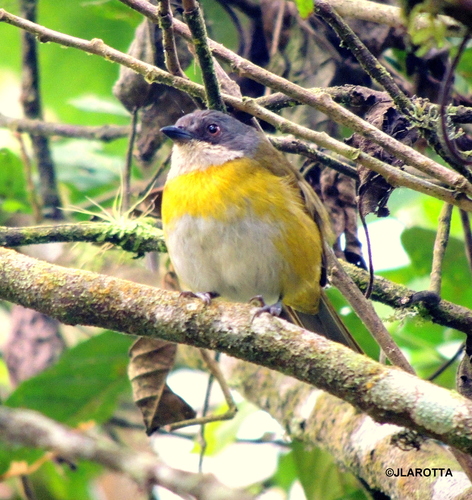
Ashy-throated Chlorospingus
Chlorospingus canigularis
A subtle beauty of the tropical highlands, the Ashy-throated Chlorospingus is the restless engine of mixed-species flocks. Its soft gray throat and olive-green plumage make it a master of camouflage in the misty cloud forests it calls home.
Quick Identification
Size
Length: 13-14 cm (5.1-5.5 in); Weight: 16-22 g (0.5-0.8 oz)
Colors
Olive-green upperparts, grayish crown and face, distinct ashy-gray throat, and yellowish-green breast and flanks.
Key Features
- Distinctive ashy-gray throat and face
- Olive-green back and wings
- Lacks the white post-ocular spot found in common bush tanagers
- Yellowish wash across the chest
When You’ll See Them
Geographic range
Where Does the Ashy-throated Chlorospingus Live?
This species is native to the lush mountainous regions of Central and South America. Its range stretches from the highlands of Costa Rica and Panama through the Andes of Colombia, Venezuela, and Ecuador, reaching as far south as central Peru. It is a specialist of mid-elevation humid forests, thriving in the corridors of the cloud forest belt where moisture and biodiversity are at their peak.
Basemap © OpenStreetMap contributors
Behavior
The Ashy-throated Chlorospingus is a social and highly active songbird, frequently serving as a core member of mixed-species foraging flocks. You will rarely find them alone; they prefer the company of other tanagers, woodcreepers, and warblers as they move through the mid-story and sub-canopy of the forest. Their movement is restless, constantly hopping between branches and occasionally hovering to glean insects from the underside of leaves.
While they are primarily forest dwellers, they are relatively tolerant of forest edges and can be seen in mature secondary growth. They don't typically visit human dwellings or bird feeders in urban centers, but if your backyard borders a tropical cloud forest or montane woodland, they are delightful visitors that add a burst of constant motion and soft, chirping vocalizations to the landscape. They are known for being quite bold within their flocks, often being among the first to investigate a new food source.
EverydayEarth exclusive
Camera Tips
Capturing the Ashy-throated Chlorospingus on camera requires a focus on their preferred vertical space. Unlike ground-dwelling birds, these bush tanagers spend most of their time in the mid-canopy or sub-canopy. If you are using a trail camera in a backyard that borders a forest, mount your camera at a height of 5 to 10 feet, angled slightly upward toward fruiting trees or thickets. They are particularly attracted to native shrubs with small berries (like Miconia species), so positioning your lens near these food sources is your best bet for a clear shot.
Because they are fast-moving, use a camera with a high trigger speed (0.2 seconds or less) and set it to take a 'burst' of 3-5 photos or a short video clip. This increases your chances of getting a sharp image as they flit between branches. During the early morning hours when light is low in the forest understory, ensure your camera has a high-quality sensor to handle the shade without excessive graininess. Look for 'natural hallways' in the vegetation where birds fly between perches.
While they don't frequent traditional seed feeders, they are highly attracted to water. A misting birdbath or a raised water feature located near cover can entice them down from the canopy. If you are using a backyard AI camera, place it near a dripping water source. Since they are residents and don't migrate, you can keep your equipment active year-round, though activity often peaks during the nesting season when they are more aggressively foraging for insects to feed their young. Using a macro-lens setting or a camera with a close focal point (around 1-2 meters) will help capture the fine details of their namesake gray throat.
Frequently Asked Questions
Record Ashy-throated Chlorospingus at your habitat
Connect a camera to start building your own species record — AI identifies every visitor automatically.