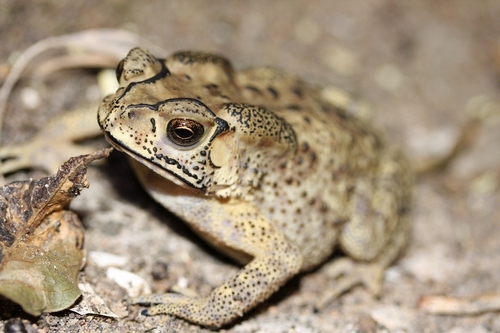
Asian Common Toad
Duttaphrynus melanostictus
Meet the Asian Common Toad, the black-spined nocturnal sentinel of Asian gardens. This hardy and adaptable amphibian is a master of the night, often found patrolling porches and garden paths in search of its next meal.
Quick Identification
Size
7–15 cm (3–6 in) in length; females are generally larger than males
Colors
Pale yellowish-brown to dark greyish-brown with dark, black-tipped warts; bony ridges on the head are highlighted in black
Key Features
- Prominent black bony ridges along the snout and above the eyes
- Thick, leathery skin covered in black-tipped warts
- Distinctive large, oval parotoid glands behind each eye
When You’ll See Them
Geographic range
Where Does the Asian Common Toad Live?
Native to the vast tropical and subtropical regions of Asia, the Asian Common Toad is one of the most widespread amphibians on the continent. Its core range spans from the edge of the Middle East in Pakistan and through the Indian subcontinent into Southern China and Southeast Asia. Beyond its native shores, it has established significant introduced populations in places like Madagascar, Mauritius, and parts of New Guinea, thriving in almost any environment that provides a bit of moisture and plenty of insects.
Basemap © OpenStreetMap contributors
Behavior
The Asian Common Toad is a robust, terrestrial amphibian known for its remarkable adaptability. Unlike many frogs that prefer to stay near deep water, this toad is a confident land-dweller that often takes up residence in human-dominated landscapes. It is primarily nocturnal, spending its days hiding in crevices, under logs, or in burrows, only to emerge at dusk to begin its nightly patrol for food. You will often see them 'walking' or hopping with short, heavy bounds rather than making the long leaps associated with aquatic frogs.
These toads have developed a commensal relationship with humans, frequently appearing on porches and in gardens. They are remarkably bold and will sit motionless under streetlights or garden lamps for hours, waiting for insects to be drawn to the light. While they are generally solitary, multiple individuals may gather in the same insect-rich 'hunting grounds' or congregate in large numbers at permanent water bodies during the breeding season to call and mate.
EverydayEarth exclusive
Camera Tips
Capturing the Asian Common Toad requires a ground-level approach. Because these toads rarely jump higher than a few inches, you should place your AI-powered camera as low as possible—ideally directly on the ground or mounted just 5 centimeters (2 inches) up. Tilt the lens slightly downward to ensure you catch the distinct black ridges on their head, which are their most identifying feature from a top-down perspective.
The secret to attracting these toads is to bait their prey rather than the toad itself. Position your camera near a low-voltage garden light or place a small, battery-operated LED near the camera's field of view. The light will attract moths, beetles, and crickets, turning the area in front of your camera into a prime hunting ground that the toad will visit night after night. A shallow dish of water embedded in the soil can also be an irresistible draw during dry spells.
Since these amphibians are nocturnal, your camera’s infrared performance is vital. Because they are ectothermic (cold-blooded), they might not always trigger standard PIR sensors that look for heat signatures. Set your camera to its highest motion sensitivity and use 'Time Lapse' mode as a backup if you know a toad frequent a specific spot. If your camera supports video, short 10-second clips are better than photos for capturing their unique 'walking' gait and the lightning-fast tongue flick used to grab prey.
Similar Species
Species that look similar or are commonly confused with Asian Common Toad.
Frequently Asked Questions
Record Asian Common Toad at your habitat
Connect a camera to start building your own species record — AI identifies every visitor automatically.