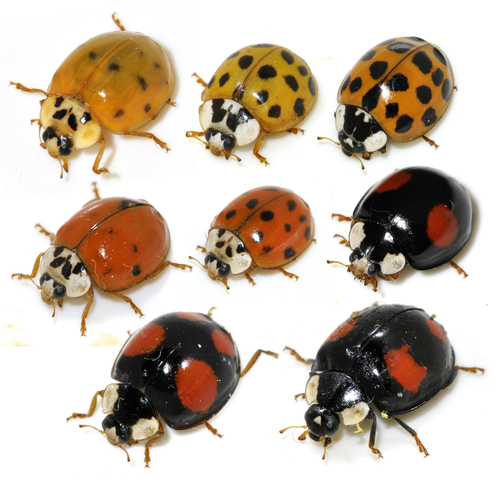
Asian Lady Beetle
Harmonia axyridis
A master of mimicry and a voracious garden protector, the Asian Lady Beetle is one of the most recognizable insects in the backyard. Distinguished by its signature 'M' marking, this beetle is a fascinating subject for macro photography enthusiasts.
Quick Identification
Size
5.5 to 8.5 mm (0.22 to 0.33 inches) in length
Colors
Extremely variable; base colors range from pale yellow and orange to bright red or black, usually with a white pronotum featuring a black 'M' or 'W' mark
Key Features
- Black 'M' or 'W' shaped mark on the white pronotum
- Highly convex, domed body shape
- Variable spot counts ranging from 0 to 22
- Noticeably larger than most native North American lady beetle species
When You’ll See Them
Geographic range
Where Does the Asian Lady Beetle Live?
The Asian Lady Beetle is native to eastern Asia, with its original range spanning from central Russia and Kazakhstan through China, Korea, and Japan. Since the late 20th century, it has become a prolific global traveler after being introduced to North America and Europe for biological pest control. Today, it is firmly established across the United States, Canada, much of South America, and throughout the European continent and parts of Africa.
Basemap © OpenStreetMap contributors
Behavior
Asian Lady Beetles are voracious and active predators, spendings their days patrolling plant foliage in search of prey. Unlike many more docile native ladybugs, this species is known for its aggressive foraging habits and its defensive 'reflex bleeding,' where it excretes a yellow, foul-smelling chemical from its leg joints when disturbed. This fluid can stain surfaces and serves as a potent deterrent against birds and other small predators.
As winter approaches, these beetles exhibit a unique social behavior known as 'overwintering aggregation.' They are attracted to high-contrast, sunlit surfaces, which often leads them to swarm the sides of light-colored houses in October. They seek out cracks and crevices to crawl inside, where they enter a state of dormancy until spring. While they do not cause structural damage, their sheer numbers indoors can make them a significant nuisance for homeowners.
EverydayEarth exclusive
Camera Tips
Capturing high-quality images of Asian Lady Beetles requires a focus on micro-habitats rather than wide-angle views. Because of their small size, you should position your camera extremely close—within a few inches—to vegetation that is prone to aphid infestations, such as rose bushes, milkweed, or vegetable patches. Using a macro lens attachment or a camera with a dedicated 'macro mode' is essential to resolve the fine details of the 'M' marking on their pronotum.
The best time to film them is during the warmest part of the day when they are most active. For the best lighting, aim for indirect but bright sunlight; direct, harsh sun can create glares on their shiny, domed wing covers (elytra). If your camera allows for manual focus, try setting it to a fixed point on a leaf where you have spotted ladybugs previously, as their movement can sometimes confuse autofocus sensors.
In the autumn months, you can capture spectacular swarm footage by mounting your camera on a tripod facing the sunny, south-facing side of a light-colored building. This is when the beetles congregate in massive numbers before entering homes. Using a high frame rate (60fps or higher) will allow you to see the intricate way they unfold their wings for flight, a process that happens too fast for the human eye to track.
Similar Species
Species that look similar or are commonly confused with Asian Lady Beetle.
Frequently Asked Questions
Record Asian Lady Beetle at your habitat
Connect a camera to start building your own species record — AI identifies every visitor automatically.