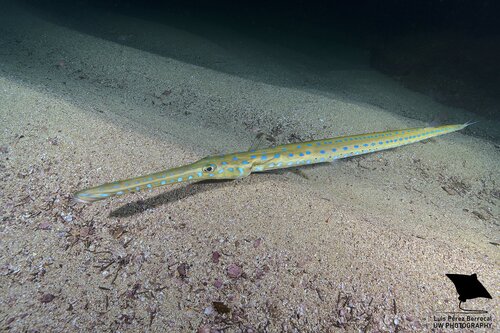
Atlantic Bluespotted Cornetfish
Fistularia tabacaria
With its whip-like tail and neon-blue spots, the Atlantic Bluespotted Cornetfish is a masterpiece of underwater stealth. This slender hunter glides through the Atlantic’s reefs, using its tube-like snout to snatch prey with lightning speed.
Quick Identification
Size
Length up to 200 cm (6.6 ft), though commonly around 100 cm (3.3 ft); extremely thin, elongated body.
Colors
Olive-green to brownish-grey upper body featuring two rows of neon blue spots or longitudinal stripes; pale to silvery underside.
Key Features
- Extremely long, tube-like snout with a small mouth at the tip
- Whip-like filament extending from the center of the forked tail
- Highly elongated, depressed body with vibrant blue markings
- Large, silvery eyes positioned for binocular vision
When You’ll See Them
Geographic range
Where Does the Atlantic Bluespotted Cornetfish Live?
This species is widely distributed throughout the Atlantic Ocean. In the Western Atlantic, its range extends from the chilly waters of New England and Bermuda southward through the Gulf of Mexico and the Caribbean to the coast of Brazil. Across the ocean in the Eastern Atlantic, it is commonly found from the Macaronesian Islands like Cape Verde down the West African coast to Angola, thriving in areas where warm currents sustain rich reef biodiversity.
Basemap © OpenStreetMap contributors
Behavior
The Atlantic Bluespotted Cornetfish is a master of mimicry and stealth. It is often observed hovering nearly motionless in the water column, frequently aligning its body with seafan branches or drifting vertically to resemble floating debris. This solitary hunter uses its slender profile to minimize its silhouette, allowing it to sneak up on unsuspecting prey with subtle movements of its fins.
Despite their length, they are remarkably agile and can burst into high-speed sprints when threatened or during a hunt. While they are generally wary of humans, they are curious enough to allow patient snorkelers or stationary cameras to observe them. In reef environments, they are known to shadow larger, non-predatory fish like parrotfish or goatfish, using the larger fish as a literal 'blind' to hide their approach from smaller prey.
EverydayEarth exclusive
Camera Tips
Capturing the Atlantic Bluespotted Cornetfish requires an underwater camera setup, such as a GoPro or a specialized reef-monitoring system. To get the best footage, mount your camera on a weighted base or a sturdy reef clamp at a depth of 2 to 5 meters. Position the camera at the 'edge' of a habitat—where a coral reef meets a sandy patch or where seagrass beds begin—as cornetfish frequently patrol these transition zones while hunting.
Because the cornetfish is exceptionally long and thin, wide-angle lenses are essential to capture the entire animal in the frame. Set your camera to record in 4K at 60 frames per second; this high frame rate is crucial for capturing their 'suction feeding' strike, which happens in a fraction of a second. Natural lighting is best in shallow water, so aim for midday sessions when the sun is directly overhead to make those neon blue spots really 'pop' against their olive-toned skin.
Avoid using heavy baits, as these tend to attract swarms of smaller reef fish that can obstruct the view or attract larger predators that might scare the cornetfish away. Instead, look for areas with high concentrations of silversides or small fry. If your camera allows for time-lapse or motion-triggering, ensure the sensitivity is high; the cornetfish's thin profile can sometimes be missed by standard motion sensors. Patience is key, as they often drift into frame slowly and stay for several minutes if the camera is stationary and silent.
Frequently Asked Questions
Record Atlantic Bluespotted Cornetfish at your habitat
Connect a camera to start building your own species record — AI identifies every visitor automatically.