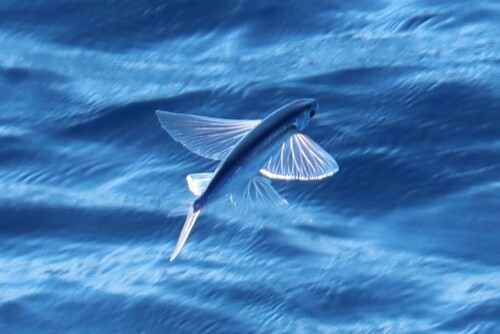
Atlantic Flyingfish
Cheilopogon melanurus
Witness the spectacular gliders of the deep. The Atlantic Flyingfish turns the ocean surface into a runway, escaping predators with breathtaking aerial displays.
Quick Identification
Size
Typically 10-12.5 inches (25-32 cm) in length, with a 'wingspan' of pectoral fins reaching up to 8 inches (20 cm).
Colors
Metallic iridescent blue or green on the back (dorsal), fading to a bright silver on the belly (ventral); pectoral fins are mostly clear or greyish.
Key Features
- Extraordinarily long, wing-like pectoral fins
- Deeply forked tail with a significantly longer lower lobe
- Cylindrical, streamlined body shape
- Large, dark eyes positioned for surface hunting
When You’ll See Them
Geographic range
Where Does the Atlantic Flyingfish Live?
Native to the Atlantic Ocean, the Atlantic Flyingfish is most abundant in the tropical and subtropical waters of the Western Atlantic. Its core range extends from the coast of Massachusetts in the United States, through the Gulf of Mexico and the Caribbean Sea, down to the shores of southern Brazil. While they are pelagic specialists, they are common seasonal visitors to coastal waters where warm currents like the Gulf Stream bring them closer to the eastern seaboard.
Basemap © OpenStreetMap contributors
Behavior
The Atlantic Flyingfish is best known for its incredible aerial glides, a defense mechanism used to escape fast-moving underwater predators like mahi-mahi, tuna, and billfish. By swimming at speeds of up to 37 miles per hour and beating its tail rapidly against the water's surface, it can launch itself into the air. Once airborne, it spreads its large pectoral fins to glide for distances exceeding 600 feet, occasionally touching the water again to flap its tail and extend the flight.
These fish are highly social and are often found in large schools, particularly in areas where ocean currents concentrate their food. They are primarily nocturnal or crepuscular in their surface activity, often being attracted to bright lights. While they spend their lives in the open ocean, they are frequently seen by humans from boats or coastal piers when the schools move closer to shore during warmer months.
EverydayEarth exclusive
Camera Tips
Capturing the Atlantic Flyingfish requires a specialized approach since they are rarely 'backyard' guests unless your backyard is a beachfront or a boat dock. For the best results, use an underwater action camera mounted to a sturdy pier piling or a weighted submersible rig. Aim the camera upward toward the surface at a 45-degree angle to capture the transition from swimming to flight. High-speed frame rates (at least 60 or 120 fps) are essential to catch the rapid vibration of the tail as they break the surface.
If you are setting up a camera on a dock or boat at night, use a submersible green or white LED fishing light. These fish are strongly attracted to light (phototactic) and will often congregate in the illuminated area to feed on the concentrated plankton. Position your AI-powered camera to trigger on movement within the light's radius. Ensure your housing is rated for saltwater and rinse it thoroughly with fresh water after every deployment to prevent salt corrosion on the lens and seals.
For those attempting to capture the 'flight' from above water, a trail camera with a fast trigger speed (0.2s or less) mounted on a pier or boat railing can work, but you will need plenty of natural light. Set the camera to 'Burst Mode' to capture a sequence of the glide. Because these fish are small and fast, a wide-angle lens is preferred over a zoom to ensure the fish stays within the frame during its erratic flight path.
Similar Species
Species that look similar or are commonly confused with Atlantic Flyingfish.
Frequently Asked Questions
Record Atlantic Flyingfish at your habitat
Connect a camera to start building your own species record — AI identifies every visitor automatically.