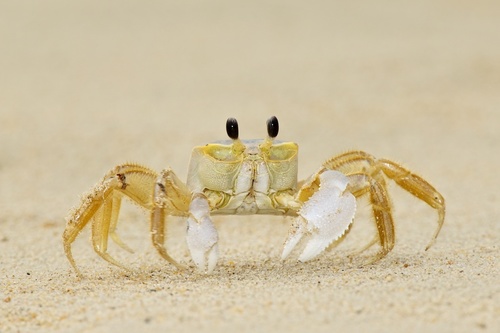
Atlantic Ghost Crab
Ocypode quadrata
A master of camouflage and the fastest sprinter on the sand, the Atlantic Ghost Crab is the moonlit guardian of the Atlantic shoreline.
Quick Identification
Size
Carapace width 1.5–2 inches (3.8–5 cm); total leg span up to 6 inches (15 cm); weight 1–2 ounces.
Colors
Pale straw-yellow, cream, or grayish-white; large black bulbous eyes; juveniles often exhibit mottled brown and white camouflage.
Key Features
- Square-shaped carapace with rounded edges
- Large, club-like eyestalks with 360-degree vision
- Asymmetrical claws (one larger than the other)
- Long, hairy legs designed for high-speed sideways running
When You’ll See Them
Geographic range
Where Does the Atlantic Ghost Crab Live?
The Atlantic Ghost Crab is the definitive beach-dweller of the Western Atlantic coastline. Its range begins at its northern limit in the sandy reaches of Massachusetts and extends southward along the entire Eastern Seaboard and the Gulf of Mexico. Beyond the United States, this species is found throughout the Caribbean islands and follows the tropical coast of South America all the way to southern Brazil, making it one of the most widely distributed shore crabs in the hemisphere.
Basemap © OpenStreetMap contributors
Behavior
Atlantic Ghost Crabs are the 'phantom' sprinters of the coastline, earned by their pale coloration that blends perfectly with dry sand and their incredible speed. Capable of moving at nearly 10 miles per hour, they dart sideways with sudden, erratic changes in direction to evade predators. They are primarily nocturnal, spending the heat of the day in deep, complex burrows that can extend four feet underground to reach the cooler, damp sand near the water table.
While they are terrestrial, these crabs are biologically tethered to the sea. They possess gills that must remain moist to function; they achieve this by wicking up moisture from damp sand or occasionally venturing into the surf to 'recharge' their gill chambers. Socially, they are quite territorial of their burrows and use a unique form of communication called stridulation—making rasping sounds by rubbing their claws against their legs—to warn off rivals or attract mates.
EverydayEarth exclusive
Camera Tips
Capturing a Ghost Crab on camera requires a low-profile setup. Place your camera just 2 to 4 inches off the ground using a ground spike or a weighted sandbag. Position the lens about 3 feet away from a fresh burrow entrance—you can identify an active 'home' by the fan-shaped pile of fresh sand outside the hole. Angle the camera slightly upward to catch the crab’s iconic stalked eyes against the horizon.
Since these crabs are most active in total darkness, a camera with high-quality infrared (IR) flash is mandatory. They are sensitive to vibrations, so avoid heavy footfalls when checking your gear. Using a 'burst mode' or high-speed trigger is highly recommended, as their movements are lightning-fast and erratic; a single shot often misses the crab entirely as it darts back into its hole.
The beach environment is hostile to electronics. Salt spray and blowing sand can scratch lenses and corrode ports within hours. Always use a weather-sealed housing or a protective silicone sleeve. After a night of filming, wipe down the exterior of your camera with a damp, fresh-water cloth to remove salt residue. If you want to keep them in front of the lens longer, a small piece of oily fish or a cracked-open clam secured with a tent stake can act as an irresistible lure.
Frequently Asked Questions
Record Atlantic Ghost Crab at your habitat
Connect a camera to start building your own species record — AI identifies every visitor automatically.