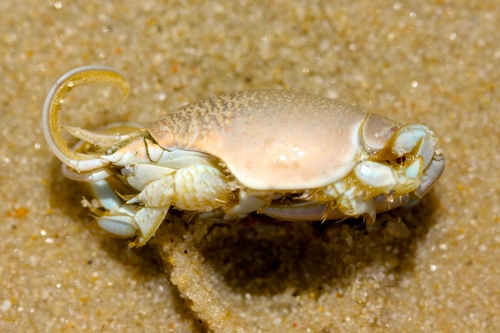
Atlantic Sand Crab
Emerita talpoida
The invisible engineers of the shoreline, Atlantic Sand Crabs are master burrowers that dance with the tides. Watch them disappear into the surf in the blink of an eye!
Quick Identification
Size
Females reach 2.5–3.5 cm (1–1.4 in); males are significantly smaller, usually under 1.3 cm (0.5 in).
Colors
Camouflaged grey, tan, or creamy white carapace designed to mimic wet sand; translucent legs and pearly underside.
Key Features
- Smooth egg-shaped carapace
- Long feathery antennae for filter feeding
- Powerful rear legs specialized for backwards digging
- Complete lack of claws or pincers
When You’ll See Them
Geographic range
Where Does the Atlantic Sand Crab Live?
Stretching across the Atlantic coast of North America, the Atlantic Sand Crab is a quintessential resident of the eastern seaboard. Its native range begins in the temperate waters of Massachusetts and extends southward through the Mid-Atlantic and Southeast United States, wrapping around the Florida peninsula and into the Gulf of Mexico. These hardy crustaceans are also commonly found along the sandy shorelines of Eastern Mexico, where they thrive in the high-energy environment of the breaking waves.
Basemap © OpenStreetMap contributors
Behavior
The Atlantic Sand Crab is a master of the 'swash zone,' the area where waves break and wash up the beach. They are famously known for their ability to disappear into the sand in a matter of seconds. By burrowing backwards, they stay protected from predators while keeping their feathery antennae exposed to the receding water to catch microscopic food. They are incredibly social in a passive way, often found in dense colonies that move up and down the beach with the changing tides.
Unlike many other crabs, they do not bite or pinch, making them a favorite for beachgoers to observe. They spend their entire lives following the tide line; if the water moves, they move with it. When a wave retreats, you might see thousands of V-shaped ripples in the sand—these are the antennae of sand crabs waiting for their next meal. Their life cycle is short, typically only two to three years, and they are a vital food source for shorebirds and fish.
EverydayEarth exclusive
Camera Tips
Capturing the Atlantic Sand Crab requires a specialized approach because of their 'wash-in, wash-out' lifestyle. Since they live in the surf, a standard trail camera on a tree won't work. Use a waterproof action camera with a weighted base plate or a 'sand spike' mount. Position the camera at the very edge of the low-tide line, facing toward the ocean at a low angle. This 'crab's eye view' allows you to capture them as they emerge from the sand and move with the waves.
Because sand crabs are small and perfectly camouflaged, macro settings are essential. If your camera has a close-focus mode, set it to trigger when it detects movement within 12 inches. To encourage them to stay in front of the lens, you can lightly disturb the sand in a small patch; the release of organic matter often attracts them to forage in that specific spot. However, avoid using heavy baits which might attract larger predators like gulls that could knock over your gear.
Nighttime is actually one of the best times for filming. Using a camera with 'night vision' or a low-intensity red LED light will reveal their activity without scaring them off. During the night, they are often less wary of shorebirds and will stay above the sand longer. Look for the 'V' shapes in the receding water to know exactly where to plant your camera. Ensure your housing is rated for saltwater and always rinse it thoroughly with fresh water after a session to prevent corrosion.
Similar Species
Species that look similar or are commonly confused with Atlantic Sand Crab.
Frequently Asked Questions
Record Atlantic Sand Crab at your habitat
Connect a camera to start building your own species record — AI identifies every visitor automatically.