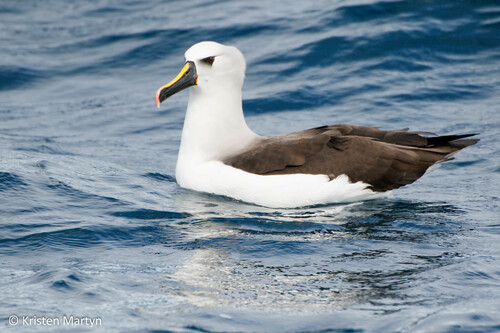
Atlantic Yellow-nosed Albatross
Thalassarche chlororhynchos
A slender master of the Southern winds, the Atlantic Yellow-nosed Albatross is easily recognized by the vibrant yellow stripe on its bill and its incredible 6-foot wingspan.
Quick Identification
Size
Length: 75–81 cm (30–32 in); Wingspan: 1.8–2.1 m (5.9–6.9 ft); Weight: 1.8–2.8 kg (4.0–6.2 lb)
Colors
White body and head; dark charcoal-grey wings and back; black bill with a bright yellow stripe along the top and a pink tip.
Key Features
- Distinctive yellow stripe (culmen) on a black bill with a pink tip
- Greyish-white head with a dark 'mascara' smudge around the eyes
- Narrow black borders on the white underwing
- Elegant, slender build compared to other albatross species
When You’ll See Them
Geographic range
Where Does the Atlantic Yellow-nosed Albatross Live?
The Atlantic Yellow-nosed Albatross is a true creature of the South Atlantic, nesting primarily on the remote Tristan da Cunha archipelago and Gough Island. During the non-breeding season, these birds disperse widely across the ocean, ranging from the coast of Brazil across to the waters of South Africa and Namibia. While they are Southern Hemisphere specialists, they occasionally appear as rare vagrants off the eastern coast of North America and Western Europe after heavy storms.
Basemap © OpenStreetMap contributors
Behavior
The Atlantic Yellow-nosed Albatross is a magnificent glider, perfectly adapted for the turbulent winds of the South Atlantic. It utilizes a technique called dynamic soaring, which allows it to cover hundreds of miles with hardly a single wingbeat by exploiting the wind speed differences near the ocean's surface. While they are mostly solitary at sea, they are deeply social during the breeding season, forming long-term pair bonds and returning to the same nesting sites for decades.
These birds are known for their ritualized courtship dances, which involve bill-clapping, sky-pointing, and soft 'mooing' calls. They are opportunistic feeders and are frequently observed following fishing vessels to scavenge for offal. Despite their large size, they are often subordinate to larger species like the Wandering Albatross or Giant Petrels when competing for food behind boats.
EverydayEarth exclusive
Camera Tips
Capturing the Atlantic Yellow-nosed Albatross on camera is a thrill for any wildlife enthusiast. Because these are pelagic birds, a standard backyard setup won't work unless you live on a coastal cliff in their range. If you are setting up a camera near a known nesting site or coastal flyway, use a high-speed shutter setting (at least 1/2000s) to freeze the motion of their wings. For island-based trail cameras, place the unit at ground level near tussock grass edges, as these birds nest on the ground and often use cleared paths as 'runways' for take-off.
Lighting is your biggest challenge at sea. If you are on a boat, use a camera with a fast autofocus system that can track a bird against a moving, high-contrast ocean background. Position your camera facing the wind; albatrosses almost always land and take off into the wind, which will give you the best head-on action shots. If using a trail camera for long-term monitoring, ensure the housing is marine-grade or protected by a salt-resistant cover, as salt spray can corrode electronics and cloud lenses in a matter of days.
For the best results, use a 'No-Glow' infrared flash if you are trying to capture their behavior at nesting sites during the early dawn or late dusk hours. This prevents the birds from being spooked by the camera. Given their status as an endangered species, always maintain a respectful distance if placing cameras manually. A telephoto lens or a zoom-capable trail cam is essential to get close-up shots of their distinctive bill markings without disturbing their natural behavior.
Similar Species
Species that look similar or are commonly confused with Atlantic Yellow-nosed Albatross.
Frequently Asked Questions
Record Atlantic Yellow-nosed Albatross at your habitat
Connect a camera to start building your own species record — AI identifies every visitor automatically.