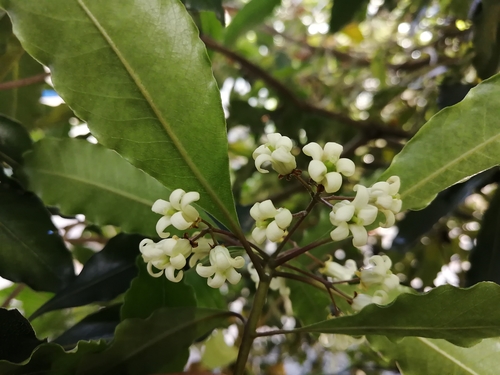
Australian Cheesewood
Pittosporum undulatum
Famed for its sweet, jasmine-like scent and vibrant orange berries, the Australian Cheesewood is a magnet for backyard birds and nocturnal pollinators alike.
Quick Identification
Size
A medium-sized tree reaching 10–15 metres (33–50 feet) in height with a canopy spread of 5–8 metres (16–26 feet).
Colors
Dark glossy green foliage; creamy white to pale yellow flowers; bright orange-yellow woody seed capsules.
Key Features
- Distinctly wavy or 'undulated' leaf margins
- Intensely fragrant bell-shaped flowers in clusters
- Spherical orange fruit capsules about 1cm wide
- Smooth, pale grey bark that becomes slightly roughened with age
When You’ll See Them
Geographic range
Where Does the Australian Cheesewood Live?
The Australian Cheesewood is native to the coastal fringes and mountain ranges of eastern Australia, spanning from south-eastern Queensland through New South Wales and into Victoria. While its heartland lies in these temperate and subtropical regions, it has successfully established itself far beyond its original borders. It is now widely naturalized in parts of Western Australia, South Africa, the Caribbean, and the United States—specifically in the coastal regions of California and Hawaii, where it is often viewed as an invasive species due to its competitive growth habits.
Basemap © OpenStreetMap contributors
Behavior
The Australian Cheesewood is a highly adaptable and opportunistic grower. While it is a valued shade tree in many gardens, its fast growth rate and dense canopy allow it to quickly dominate the mid-storey of a forest, often shading out smaller native plants. It is particularly known for its intense fragrance, which is most potent during the spring evenings when its flowers are in full bloom.
This species has a clever strategy for reproduction. It produces small, sticky seeds inside bright orange capsules that are irresistible to birds. Once the fruit splits open, the seeds are eaten and transported far and wide. Because it is so resilient to different soil types and light levels, it has become a successful 'colonizer' in suburban environments and disturbed bushland, often popping up along fence lines where birds have perched.
EverydayEarth exclusive
Camera Tips
When monitoring an Australian Cheesewood, your primary goal is to capture the diverse birdlife it attracts. During the autumn months, position your camera at a slight downward angle toward a cluster of ripe, orange seed capsules. Many birds, such as Currawongs, Silvereyes, and Satin Bowerbirds, will visit frequently to feed on the sticky seeds. To get the best shots, use a high-speed trigger setting, as these birds are often fast and flighty when foraging.
Because the tree's flowers are famously fragrant at night, it also attracts a variety of nocturnal pollinators. If your AI camera has infrared night vision, try mounting it near flower clusters in late spring. You might capture interesting footage of moths or even nectar-feeding possums that are drawn to the scent. Ensure the camera is secured tightly to a sturdy branch, as the tree's dense foliage can catch the wind and cause 'false triggers' if the camera moves.
For those interested in the tree's life cycle, a time-lapse setting is ideal. Set your camera to take a photo once a day from the same position to watch the transition from the white, star-like flowers to the bright orange berries. This provides a fascinating look at the seasonal rhythms of backyard flora. If the tree is in a shaded gully, consider adjusting your exposure settings upward to compensate for the deep shade created by the tree's own thick canopy.
Frequently Asked Questions
Record Australian Cheesewood at your habitat
Connect a camera to start building your own species record — AI identifies every visitor automatically.