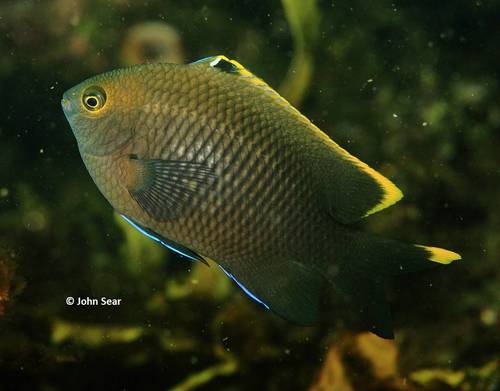
Australian Gregory
Plectroglyphidodon apicalis
The Australian Gregory is the feisty gardener of the Pacific reefs, famous for its golden-tipped fins and its fearless defense of its private algae patch.
Quick Identification
Size
Reaches a maximum length of approximately 15 cm (6 inches), though most individuals are seen around 10 cm (4 inches).
Colors
Body is typically a dusky brown to grayish-olive with dark-edged scales; the most striking feature is the bright yellow to orange-gold highlights on the tips of the dorsal and anal fins.
Key Features
- Golden-yellow or orange tips on the dorsal and anal fins
- Scales with dark margins creating a mesh-like appearance
- Deep, oval-shaped body typical of damselfish
- Highly aggressive and territorial behavior toward intruders
When You’ll See Them
Geographic range
Where Does the Australian Gregory Live?
The Australian Gregory is a native resident of the Western Pacific Ocean, with its primary stronghold situated along the eastern coast of Australia. Its range extends through the tropical waters of the Great Barrier Reef in Queensland and reaches down into the more temperate rocky reefs of New South Wales. This species has also been documented further afield in the waters surrounding Taiwan and the Loyalty Islands, where it occupies similar shallow-water reef niches.
Basemap © OpenStreetMap contributors
Behavior
The Australian Gregory is best known for its role as a dedicated "algae farmer." This damselfish claims a specific patch of reef or rock, where it meticulously tends to a garden of filamentous algae. It is remarkably territorial, vigorously defending its plot against much larger fish, sea urchins, and even human snorkelers. By chasing away other herbivores, it ensures its food supply remains lush and undisturbed.
In terms of social structure, the Gregory is primarily solitary and spends most of its daylight hours patrolling the boundaries of its territory. It has a complex relationship with its environment, as its "weeding" of the reef can actually influence which types of coral and algae grow in its immediate vicinity. Despite their small size, they are fearless, often darting out from crevices to perform threat displays or rapid nips at perceived threats.
EverydayEarth exclusive
Camera Tips
Capturing high-quality footage of the Australian Gregory requires an underwater-rated camera or a dedicated reef housing. The secret to success lies in their territorial nature. Unlike many reef fish that flee at the sight of equipment, a Gregory is likely to stand its ground. Look for a patch of rock with a noticeable "carpet" of fine algae; if you see a small brown fish darting at other passersby, you have found a territory. Place your camera on a weighted base or a small tripod about 30 cm from the edge of this patch, ensuring it is secure enough to withstand the surge.
Natural lighting is your best friend when filming underwater. Try to schedule your camera placement during the middle of the day when the sun is highest in the sky. This allows the light to penetrate the shallow water and truly illuminate the golden-yellow tips of the fins, which can otherwise look dull in low light. Because these fish move in quick, erratic bursts, use a camera setting with a high frame rate (at least 60fps) to ensure the AI can clearly identify the fin markings and scale patterns during playback.
You do not need to use bait to attract this species. In fact, adding bait may attract larger predators that will scare the Gregory into its hiding hole. Instead, rely on its curiosity and defensive instincts. The fish will likely approach the camera to inspect the "intruder" in its garden, providing excellent close-up opportunities. Ensure your lens is clean and free of salt spots before deployment, and if possible, use a wide-angle lens to capture the fish's interactions with other reef inhabitants that wander too close to its borders.
Frequently Asked Questions
Record Australian Gregory at your habitat
Connect a camera to start building your own species record — AI identifies every visitor automatically.