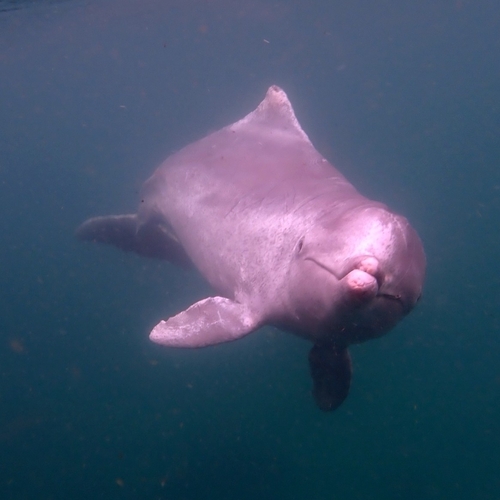
Australian Humpback Dolphin
Sousa sahulensis
An elusive coastal icon, the Australian humpback dolphin is a master of the shallows, recognized by its unique dorsal hump and shy, mysterious nature.
Quick Identification
Size
Adults measure 2.5 to 2.8 metres (8.2 to 9.2 feet) and weigh between 230 and 280 kilograms (500 to 620 pounds).
Colors
Typically slate-gray to dark gray on the back and sides, fading to a lighter gray or off-white on the belly. Some adults develop white mottling or scarring on the dorsal fin.
Key Features
- Distinctive fatty hump below the dorsal fin
- Long, slender rostrum (beak) unlike the snubfin dolphin
- Small, slightly hooked (falcate) dorsal fin situated on the hump
- Broad flukes with a distinct median notch
When You’ll See Them
Geographic range
Where Does the Australian Humpback Dolphin Live?
The Australian humpback dolphin is native to the Sahul Shelf region, primarily found along the northern half of the Australian continent. Its range extends from the Ningaloo Reef in Western Australia, across the Top End of the Northern Territory, and down the Queensland coast to the New South Wales border. It is also found in the coastal waters of southern New Guinea and parts of the Indonesian archipelago, staying strictly within the shallow waters of the continental shelf.
Basemap © OpenStreetMap contributors
Behavior
The Australian humpback dolphin is known for being more elusive and shy compared to the more gregarious bottlenose dolphin. They typically travel in small, tight-knit pods of 5 to 10 individuals, though they occasionally form larger groups for feeding or socializing. Unlike many other dolphins, they rarely engage in bow-riding with vessels and tend to maintain a respectful distance from human activity.
These dolphins exhibit a unique surfacing pattern where the long beak emerges first, followed by the distinctive hump and then the small dorsal fin. Their social structure is complex, often involving 'fission-fusion' societies where group composition changes frequently throughout the day. They are highly vocal, using a series of clicks, whistles, and burst-pulses for navigation and communication in the often-murky coastal waters.
EverydayEarth exclusive
Camera Tips
Capturing the Australian humpback dolphin on a shore-based camera requires strategic placement near river mouths or narrow estuarine channels where the dolphins are forced to pass closer to land. Because these dolphins are 'low-profile' surfers, mount your camera at a height of at least 2 to 3 metres above the high-tide mark to get a better downward angle into the water. This helps the AI distinguish the dolphin's hump from wave chop.
Using a circular polarizing filter is essential for reducing water surface glare, which can otherwise blind your camera's sensor during the bright midday sun. If your camera supports it, set the shutter speed to at least 1/1000th of a second to freeze the action of a dorsal fin or a tail slap. Since these dolphins are shy, avoid using any bright artificial lights at night; instead, rely on high-sensitivity sensors or thermal triggers if your equipment allows.
Timing is everything with this species. Program your camera to be most active during the flood tide (incoming tide), as the dolphins often follow schools of baitfish into estuaries during this window. Look for 'choke points' like sandbar gaps or rocky outcrops where the water is at least 2 metres deep. Unlike trail cameras for land animals, motion detection can be tricky over moving water, so using a 'time-lapse' mode with short intervals (1-5 seconds) during peak tidal windows is often the most effective strategy.
Similar Species
Species that look similar or are commonly confused with Australian Humpback Dolphin.
Frequently Asked Questions
Record Australian Humpback Dolphin at your habitat
Connect a camera to start building your own species record — AI identifies every visitor automatically.