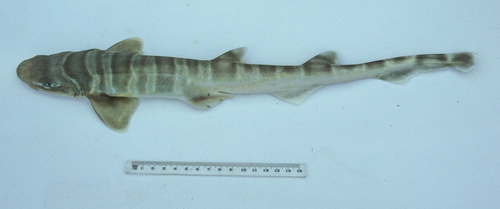
Australian Sawtail Catshark
Figaro boardmani
A masterpiece of deep-sea camouflage, the Australian Sawtail Catshark is defined by its ornate white-edged saddles and unique, saw-like tail. This elusive resident of the southern Australian shelf remains one of the ocean's most beautifully patterned mysteries.
Quick Identification
Size
Up to 61 cm (24 in) in length; typically weighs less than 1.5 kg (3.3 lbs)
Colors
Light grayish-brown base with 11-13 broad, dark brown saddle-like bands across the back, each meticulously outlined with a thin white or cream-colored border.
Key Features
- Distinct saw-like crests of enlarged dermal denticles along the top and bottom of the tail
- Eel-like, slender body with a blunt snout
- Broad dark saddles with high-contrast white outlines
When You’ll See Them
Geographic range
Where Does the Australian Sawtail Catshark Live?
Where Does the Australian Sawtail Catshark Live? This specialized shark is found exclusively in the temperate and subtropical waters surrounding the southern half of the Australian continent. Its range extends from the sun-drenched waters off southern Queensland, wrapping around New South Wales, Victoria, and South Australia, reaching as far west as the Great Australian Bight. It is a true endemic, meaning you won't find this specific sawtail anywhere else in the world's oceans.
Basemap © OpenStreetMap contributors
Behavior
The Australian Sawtail Catshark is a predominantly benthic (bottom-dwelling) species that leads a relatively slow-paced life in the dark depths of the ocean. Unlike their more famous predatory cousins, these sharks do not constantly cruise the open water; instead, they stay close to the seafloor, using an undulating, eel-like swimming motion to navigate the sandy or muddy substrates of the continental slope.
While they are largely solitary, they are not strictly territorial and may congregate in areas where food is particularly abundant. Their interactions with humans are virtually non-existent due to their deep-water habitat, though they are frequently encountered by deep-sea research equipment and commercial fishing trawlers. They are harmless to humans, possessing small teeth designed for grasping slippery prey rather than biting large animals.
EverydayEarth exclusive
Camera Tips
Capturing the Australian Sawtail Catshark requires specialized underwater equipment rather than a standard backyard setup. For those using deep-sea Baited Remote Underwater Video (BRUV) systems, the best results are achieved at depths between 200 and 500 meters along the Australian continental slope. Use a heavy-duty, pressure-rated housing and ensure your camera is equipped with high-powered LED floodlights, as natural light does not penetrate to these depths.
To draw the catshark into the camera's field of view, use a perforated bait canister filled with oily fish like sardines or mackerel. The scent trail is essential for attracting these sharks in the vast darkness. Position the camera facing a clear patch of sandy or muddy seafloor to allow the shark's intricate saddle patterns and 'sawtail' denticles to be clearly visible against the substrate.
Set your camera to record in high-frame-rate video if possible, as their movement is slow and serpentine. Because these sharks are sluggish, a 30-second trigger interval is usually sufficient to capture several passes. Make sure your mounting system is stable enough to withstand deep-sea currents, which can be surprisingly strong along the shelf edge.
Similar Species
Species that look similar or are commonly confused with Australian Sawtail Catshark.
Frequently Asked Questions
Record Australian Sawtail Catshark at your habitat
Connect a camera to start building your own species record — AI identifies every visitor automatically.