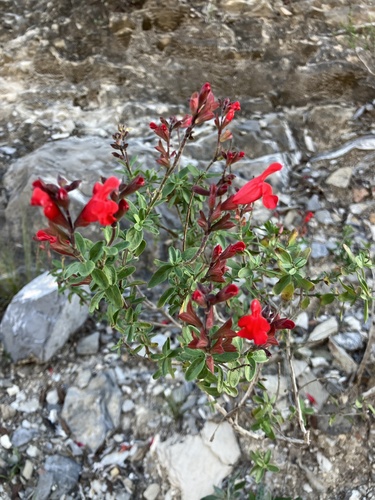
autumn sage
Salvia greggii
A vibrant cornerstone of the Southwest landscape, autumn sage is a sun-loving perennial that brings a burst of color to rocky soils. Its aromatic leaves and nectar-rich flowers make it a bustling hub for hummingbirds and pollinators throughout the year.
Quick Identification
Size
A mounding shrub reaching 2 to 3 feet (60–90 cm) in height and width
Colors
Flowers vary by cultivar including crimson red, rose pink, purple, and white; foliage is a dull minty green
Key Features
- Small, smooth-edged elliptical leaves with a distinct spicy scent
- Two-lipped tubular flowers occurring in pairs
- Woody, brittle branches forming a dense, rounded shrub
When You’ll See Them
Geographic range
Where Does the autumn sage Live?
Autumn sage is a native treasure of the North American continent, specifically localized to the rugged landscapes of the American Southwest and Northern Mexico. Its core range extends from the rocky canyons of southwest Texas through the high-elevation expanses of the Chihuahuan Desert, reaching as far south as the Mexican state of San Luis Potosí. While native to these arid regions, it has been introduced as a popular landscape plant across much of the southern United States and Mediterranean climates worldwide.
Basemap © OpenStreetMap contributors
Behavior
Autumn sage is a hardy, semi-evergreen perennial known for its resilient nature and exceptional drought tolerance. While it has a woody base, its upper stems are herbaceous and produce a profusion of flowers from spring through the first hard frost. Unlike many desert plants, it maintains a tidy, mounding shape without aggressive pruning, making it a favorite for both wild landscapes and curated suburban gardens.
This plant plays a vital ecological role as a primary nectar source in arid environments. It has evolved a symbiotic relationship with its pollinators; the floral structure is perfectly shaped to deposit pollen on the heads of visiting hummingbirds. When brushed against or heated by the sun, the foliage releases aromatic oils that act as a natural deterrent to deer and rabbits, allowing it to thrive where other ornamentals might be grazed.
EverydayEarth exclusive
Camera Tips
To capture the true beauty of autumn sage, position your camera at a low angle, approximately 18 to 24 inches off the ground, aiming slightly upward at a cluster of active blooms. This perspective highlights the unique 'hooded' shape of the flowers and provides a clear view of the pollinators that frequent them. Because the branches can be thin and move easily in the wind, try to place the camera on the leeward side of the plant or use a faster shutter speed to avoid motion blur on the foliage.
Since autumn sage is a magnet for hummingbirds and large butterflies, set your AI camera to its highest sensitivity for small, fast-moving objects. The best action occurs in the early morning and late afternoon when the light is soft and nectar production is at its peak. Avoid using heavy baits; the flowers themselves are the primary attractant. However, ensuring the plant is well-hydrated during dry spells will increase nectar flow and lead to more frequent visitor 'hits' on your camera.
For a unique perspective, try a time-lapse setting during the spring or late summer blooming surges. Setting your camera to take a photo every 15 minutes over several days can reveal the fascinating way the plant responds to the sun and how individual flowers wither and are replaced. If your camera supports it, macro mode is excellent here for capturing the fine hairs on the calyx and the sticky glands on the stems that help protect the plant from crawling insects.
Frequently Asked Questions
Record autumn sage at your habitat
Connect a camera to start building your own species record — AI identifies every visitor automatically.