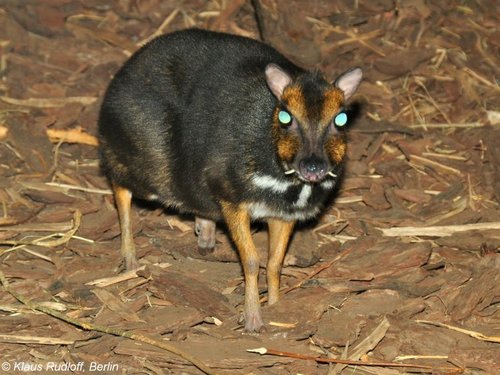
Balabac Chevrotain
Tragulus nigricans
Meet the Philippines' 'living fossil,' a miniature hoofed marvel no larger than a house cat. Found only on a handful of islands, the Balabac Chevrotain is an enchanting bridge to the ancient past of ungulate evolution.
Quick Identification
Size
Length: 40-50 cm (16-20 in); Shoulder Height: 18 cm (7 in); Weight: 0.7-1.5 kg (1.5-3.3 lbs)
Colors
Dark brown to nearly black upperparts with orange-brown flanks; white underparts; three distinct white stripes on the throat.
Key Features
- Smallest hoofed mammal in the Philippines
- Elongated canine 'tusks' in males instead of antlers
- Horizontal pupils providing wide peripheral vision
- Slender, pencil-thin legs with an arched back
When You’ll See Them
Geographic range
Where Does the Balabac Chevrotain Live?
This elusive mammal is native to the Southeast Asian archipelago, specifically found within the Palawan Faunal Region of the Philippines. Its core range is extremely restricted, limited primarily to the island of Balabac and the neighboring smaller islands of Ramos and Bugsuc. Because it is a localized endemic, you won't find this unique mouse-deer anywhere else in the wild outside of this small island cluster southwest of mainland Palawan.
Basemap © OpenStreetMap contributors
Behavior
The Balabac Chevrotain, locally known as the pilandok, is a reclusive and primarily nocturnal ruminant. Unlike true deer, they lack antlers; instead, males possess elongated, tusk-like upper canine teeth used for defense and competing for mates. They are largely solitary creatures, navigating the dense forest floor with remarkable stealth. Their shy nature makes them difficult to observe, as they tend to freeze or dash into thick undergrowth at the slightest disturbance.
Despite their diminutive size, they are territorial and mark their paths using scent glands located under their chin. While they are ruminants with a multi-chambered stomach, their lifestyle is more akin to a large rodent or a primitive ungulate, spending the daylight hours hiding in hollow logs or thick vegetation before emerging at dusk to forage for fallen fruits and leaves.
EverydayEarth exclusive
Camera Tips
Capturing the Balabac Chevrotain on camera requires patience and strategic placement due to their extreme shyness and nocturnal habits. Position your camera very low to the ground—no higher than 6 to 10 inches—to match their small stature. Angle the lens to be level with the forest floor or slightly upward if placing it on a slope. Focus your efforts on established game trails or near the base of large fruit-bearing trees, as these animals frequently return to reliable food sources.
Since they are most active under the cover of darkness, ensure your camera has a high-quality 'no-glow' infrared flash that won't startle them. Avoid using standard white light flashes, which might cause them to flee and avoid the area for days. Setting your camera to a 15-30 second video mode is highly recommended, as they move with a quick, delicate, and sometimes jerky gait that can be difficult to appreciate in a single still photo. The video will also help you spot the characteristic 'eye shine' from their horizontal pupils.
In terms of timing, while they can be seen year-round, the dry season often forces them to visit permanent water sources more frequently, making stream banks an excellent spot for camera traps. Ensure your camera's trigger speed is set to its fastest possible setting (0.2s or faster if available), as these 'mouse-deer' can vanish into the shadows in the blink of an eye. If you are in their native range, look for areas with dense leaf litter where their foraging footsteps might give away their location.
Frequently Asked Questions
Record Balabac Chevrotain at your habitat
Connect a camera to start building your own species record — AI identifies every visitor automatically.