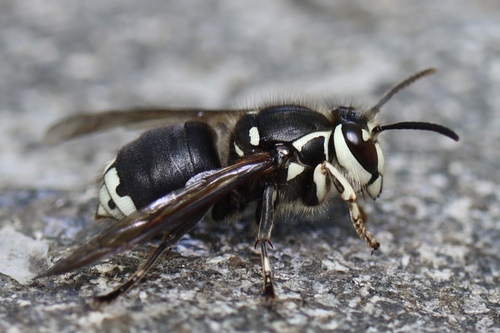
Bald-faced Hornet
Dolichovespula maculata
The Bald-faced Hornet is the master architect of the backyard, known for its striking ivory mask and impressive hanging paper nests. While they have a fierce reputation, these beneficial predators play a vital role in controlling pest populations.
Quick Identification
Size
Workers range from 12–15 mm (0.5–0.6 in); queens are significantly larger, reaching up to 20 mm (0.8 in).
Colors
Deep black body with distinctive ivory or white markings on the face, thorax, and the tip of the abdomen.
Key Features
- Distinctive white or ivory 'mask' on the face
- Large, grey, football-shaped aerial paper nest
- Stocky black body with white markings on the tail
- Three white stripes on the thorax
- Aggressive colony defense behavior
When You’ll See Them
Geographic range
Where Does the Bald-faced Hornet Live?
Native to the North American continent, the Bald-faced Hornet is found across nearly the entire United States and southern Canada. Its range extends from the Atlantic coast to the Pacific, thriving in most temperate regions where suitable nesting trees and prey are abundant.
Basemap © OpenStreetMap contributors
Behavior
Bald-faced Hornets are eusocial wasps that live in complex colonies centered around a single queen. They are renowned for their architectural skills, constructing large, pear-shaped nests made of chewed wood fibers mixed with saliva, which creates a durable grey paper. These nests are typically found hanging from tree branches or building eaves. While they are often feared for their sting, they are generally focused on colony maintenance and foraging unless their nest is directly disturbed.
Within the colony, there is a clear division of labor. Workers spend their days hunting for protein to feed the developing larvae and gathering nectar for their own energy. They are highly intelligent navigators and possess a sophisticated communication system. Interestingly, they are one of the few wasp species that can squirt venom from their stingers into the eyes of vertebrate intruders, making them formidable defenders of their home.
EverydayEarth exclusive
Camera Tips
To capture high-quality footage of Bald-faced Hornets, focus your camera on foraging hotspots rather than just the nest. They are particularly attracted to late-summer blooms like goldenrod, sedum, and aster. Position your camera about 24 to 36 inches away from these flowers. Because these insects move with incredible speed, use a camera with a fast trigger speed and high-frame-rate video settings to avoid a blurry image. Mid-morning light is ideal, as the bright sun helps illuminate the white facial markings against their dark bodies.
If you have located a nest and wish to monitor it, safety is paramount. Never mount a camera directly to the branch holding the nest, as the vibrations will alert the colony. Instead, use a tripod or mount the camera on a nearby structure at least 10-15 feet away. Use a telephoto or zoom lens to get a close-up view of the entrance hole, which is usually located at the bottom of the structure. This is the best place to see workers bringing back 'meat balls' of chewed insects for the larvae.
In late summer, you can lure them into the camera's view by placing a small dish of sugar water or overripe fruit like peaches or grapes in a sunny spot. This is especially effective in September when the colony is at its peak size and the demand for energy is high. If you are using an AI-powered camera, ensure the 'Insect' or 'Small Animal' detection setting is active, and try to keep the background simple to help the AI focus on the hornet's high-contrast markings.
Similar Species
Species that look similar or are commonly confused with Bald-faced Hornet.
Frequently Asked Questions
Record Bald-faced Hornet at your habitat
Connect a camera to start building your own species record — AI identifies every visitor automatically.