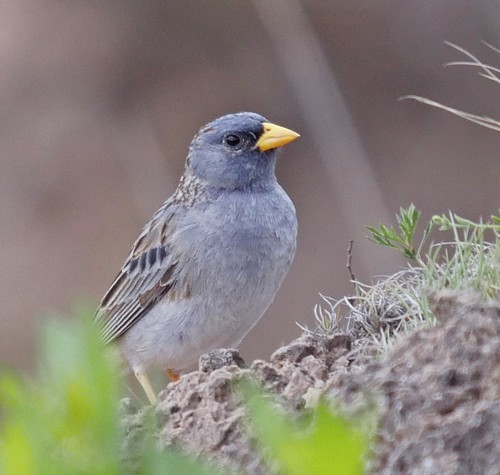
Band-tailed Sierra-Finch
Rhopospina alaudina
A hardy resident of the high Andes and coastal scrub, the Band-tailed Sierra-Finch is famous for its striking tail flashes and its ability to thrive in South America's most rugged landscapes.
Quick Identification
Size
Length 14-16 cm (5.5-6.3 inches); weight approximately 20-28g (0.7-1 oz)
Colors
Males have blue-grey heads and chests with brown-streaked backs; females are buffy-brown with heavy dark streaking. Both sexes have a diagnostic white band across the mid-tail.
Key Features
- Prominent white band across the tail
- Blue-grey hood and breast on males
- Heavy dark streaking on back
- Conical, pale-colored bill
- Strongly associated with arid shrublands
When You’ll See Them
Geographic range
Where Does the Band-tailed Sierra-Finch Live?
This resilient finch is native to the western side of the South American continent, primarily inhabiting the Andean regions. Its range extends from the coastal hills and mountain slopes of Ecuador and Peru through the highlands of Bolivia and down into central Chile and western Argentina. It thrives in the transition zones between lush valleys and the high-altitude Puna, occasionally wandering into suburban edges in search of food.
Basemap © OpenStreetMap contributors
Behavior
The Band-tailed Sierra-Finch is a social ground-dweller often found in small groups or mixed-species flocks outside of the breeding season. They spend much of their day hopping across open ground or through low-lying scrub, searching for seeds and small invertebrates. When disturbed, the flock typically rises together in a synchronized flight, showcasing the bright white bands on their tails that give the species its name.
During the breeding season, males become quite vocal and territorial. They are known for their song flights, where they ascend briefly into the air while singing a series of thin, buzzing notes before parachuting back down to a favorite perch. While they are naturally birds of the wild shrublands, they have adapted well to human presence and are a common sight in rural gardens and agricultural fields where water and spilled grain are available.
EverydayEarth exclusive
Camera Tips
To capture the best footage of a Band-tailed Sierra-Finch, position your camera low to the ground, ideally between 12 and 18 inches. These birds are dedicated ground foragers, so aiming your lens at a patch of bare earth or short grass near a protective shrub will yield much better results than placing a camera at eye level. A wide-angle setting is preferable to capture their social behavior within a flock.
In the arid regions where this species lives, water is an irresistible lure. A shallow bird bath or even a simple terracotta saucer filled with fresh water will attract them daily. Position your camera to face the water source from a distance of 3 to 5 feet, ensuring the sun is behind the camera to highlight the subtle blue-grey plumage of the males. If using birdseed as a lure, small millet or cracked corn scattered directly on the ground is more effective than using hanging feeders, which they often avoid.
Because these birds are small and move with rapid, jerky motions, set your camera to a high shutter speed or use a 'burst' photo mode. This increases your chances of catching the moment they spread their tails, which is essential for confirming the identification of the species via the white tail band. Peak activity is usually shortly after sunrise, so make sure your camera's batteries are fresh and ready for the early morning rush.
Similar Species
Species that look similar or are commonly confused with Band-tailed Sierra-Finch.
Frequently Asked Questions
Record Band-tailed Sierra-Finch at your habitat
Connect a camera to start building your own species record — AI identifies every visitor automatically.