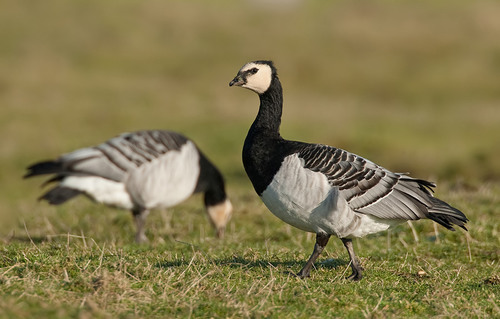
Barnacle Goose
Branta leucopsis
With its striking monochrome plumage and unique dog-like bark, the Barnacle Goose is a master of the Arctic and European coastlines. Once a mystery of the natural world, this elegant bird is now a favorite sight for winter birdwatchers and backyard observers alike.
Quick Identification
Size
Length: 58–70 cm (23–28 in); Wingspan: 132–145 cm (52–57 in); Weight: 1.2–2.2 kg (2.6–4.9 lb)
Colors
Stark white face with a black cap, neck, and breast; silver-grey upper wings with black-and-white barring; white underbelly
Key Features
- Distinctive creamy-white face surrounded by black plumage
- Black neck and chest forming a sharp contrast against white belly
- Silver-grey wings with intricate black and white 'barnacle' barring
- Small, stubby black bill and black legs
When You’ll See Them
Geographic range
Where Does the Barnacle Goose Live?
Native to the North Atlantic and Arctic regions, the Barnacle Goose primarily breeds on the rocky cliffs of Greenland, Svalbard, and Novaya Zemlya. During the winter months, they migrate south to the temperate coastal regions of the United Kingdom, Ireland, and the Netherlands. While once strictly migratory, thriving naturalized populations can now be found year-round in parklands and wetlands across much of Northern and Western Europe.
Basemap © OpenStreetMap contributors
Behavior
Barnacle Geese are highly social birds, often seen in large, noisy flocks that move with surprising coordination. They are famous for their dramatic nesting habits on high Arctic cliffs, a strategy used to avoid land-based predators like Arctic foxes. In their wintering grounds, they are frequently found grazing in coastal pastures and saltmarshes, where they maintain a vigilant, communal watch for threats.
During the day, they spend the majority of their time foraging on short grass. They have a distinct 'yapping' call that sounds remarkably like a small dog, which helps keep the flock together during flight or in low-visibility conditions. While once strictly wary of humans, many naturalized populations in urban parks have become quite approachable, though they still maintain a strong flock hierarchy.
EverydayEarth exclusive
Camera Tips
To capture the best footage of Barnacle Geese, position your camera near low-lying grassy areas or the edges of freshwater ponds where they gather to drink and bathe. Since these geese are relatively short, a low mounting height of about 12 to 18 inches is ideal. Aim the camera horizontally or with a very slight upward tilt to capture the striking contrast of their white faces and black necks against the landscape. If your camera is near a water edge, ensure it is secure, as these birds can be curious and may occasionally nudge equipment.
Timing is critical for these birds. They are most active in the early morning and late afternoon when they move between roosting sites and feeding grounds. In wintering areas, focus your efforts during the months of October through March. If you are tracking a resident population in a park or garden, use a burst mode setting on your camera; Barnacle Geese move quickly while grazing, and multiple shots will help you get that perfect, sharp image of their intricate wing patterns which can often be blurred by movement.
While we don't recommend 'baiting' in the traditional sense, maintaining a patch of short, succulent grass is the best natural lure. They are attracted to open spaces with high visibility, so ensure your camera has a wide-angle view rather than being tucked into dense brush. This species is easily spooked by sudden movements, so a well-camouflaged, silent camera is a must. Avoid high-frequency trigger settings that might be tripped by wind-blown grass, as the constant movement of a feeding flock can quickly fill up your storage card.
Similar Species
Species that look similar or are commonly confused with Barnacle Goose.
Frequently Asked Questions
Record Barnacle Goose at your habitat
Connect a camera to start building your own species record — AI identifies every visitor automatically.