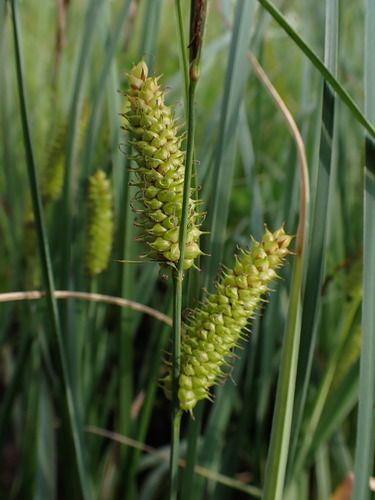
beaked sedge
Carex rostrata
A hardy wetland specialist, the beaked sedge is famous for its bottle-shaped fruit and striking blue-green foliage. This essential plant creates the structural heart of northern marshes and bogs.
Quick Identification
Size
Grows 30 to 100 cm (12 to 40 inches) in height with leaves 2 to 5 mm wide
Colors
Glaucous blue-green foliage with yellowish-brown to straw-colored seed heads
Key Features
- Bottle-shaped seed heads (perigynia) with distinct long beaks
- Leaves are glaucous blue-green and often channeled or U-shaped
- Stems are mostly smooth and obtusely triangular
- Forms dense colonies via spreading underground rhizomes
When You’ll See Them
Geographic range
Where Does the beaked sedge Live?
The beaked sedge is a classic circumpolar species native to the temperate and subarctic regions of the Northern Hemisphere. It is widely distributed across North America, from the marshes of Alaska and Canada down into the northern United States, particularly around the Great Lakes and the Pacific Northwest. Across the Atlantic, it thrives throughout Europe, the British Isles, and across Northern Asia to Japan, favoring glaciated landscapes with abundant freshwater.
Basemap © OpenStreetMap contributors
Behavior
During the spring and summer, it undergoes a rapid growth phase, sending up flowering culms that eventually bear the characteristic 'beaked' fruit. While it doesn't move, it 'behaves' as a primary architect of its environment, providing nesting material for birds and a sturdy substrate for aquatic insects. In the autumn, the plant turns a golden hue and often remains standing through the winter, providing structural cover for small mammals beneath the snow.
EverydayEarth exclusive
Camera Tips
When monitoring beaked sedge with a trail camera, your goal is likely to capture the diverse wildlife that uses the sedge for cover or food. Position your camera on a sturdy stake or tripod at a low angle, roughly 12 inches above the water or mud line. This 'frog's eye view' allows the AI to clearly see the silhouette of the bottle-shaped seed heads against the sky or water, making species identification much more reliable.
Because beaked sedge is stationary, it provides an excellent backdrop for capturing motion-triggered events. Set your camera's PIR (Passive Infrared) sensor to high sensitivity if you are looking for small visitors like dragonflies or marsh wrens. To capture the growth of the sedge itself, utilize a time-lapse mode, taking one photo every 24 hours at noon to see the seed heads transition from green to golden brown over the season.
Pay close attention to lighting; the glaucous, waxy coating on the leaves can cause significant glare in direct midday sun. For the best photos, position the camera facing north or south to catch the side-lighting of the morning and evening sun, which highlights the texture of the beaked perigynia. If you are using an AI camera to track herbivores, place the unit near the edge of a dense stand where deer or muskrats are likely to enter or exit the wetland.
Frequently Asked Questions
Record beaked sedge at your habitat
Connect a camera to start building your own species record — AI identifies every visitor automatically.