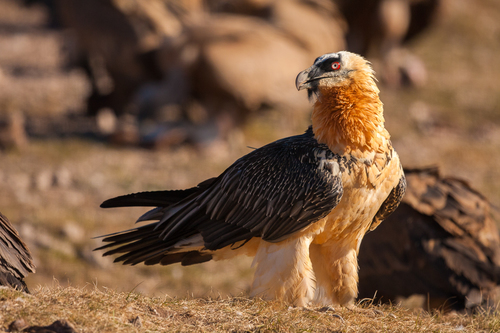
Bearded Vulture
Gypaetus barbatus
The legendary 'Bone Breaker' of the mountains, the Bearded Vulture is a prehistoric-looking marvel of the high peaks. Known for its incredible diet of bone marrow and its stunning orange plumage, it is one of the rarest and most striking raptors you can encounter.
Quick Identification
Size
Length: 94–125 cm (37–49 in); Wingspan: 2.3–2.8 m (7.5–9.2 ft); Weight: 4.5–7.8 kg (10–17 lb)
Colors
Rusty orange or creamy white head and belly, dark charcoal-grey wings and tail, black mask and 'beard'
Key Features
- Distinctive black 'beard' of bristles hanging from the lower beak
- Long, diamond-shaped tail visible in flight
- Cream-colored head with a stark black mask through the eyes
- Massive wingspan with narrow, pointed wingtips
When You’ll See Them
Geographic range
Where Does the Bearded Vulture Live?
The Bearded Vulture is a majestic resident of the high mountain ranges across three continents. Native to the rugged peaks of Southern Europe, Central Asia, and East Africa, its range extends from the Pyrenees and the Alps across to the Caucasus and the vast Himalayan massif. In Africa, core populations thrive in the Ethiopian Highlands and the Drakensberg Mountains of South Africa, while isolated groups persist in parts of the Middle East.
Basemap © OpenStreetMap contributors
Behavior
The Bearded Vulture is a master of the mountain thermals, spending hours soaring over rugged peaks with minimal effort. Unlike most vultures, they are largely solitary birds, though they may form small family groups or congregate near a significant carcass. They are famously known as 'bone-breakers' because of their unique method of consuming large bones that other scavengers cannot eat. When a bone is too large to swallow whole, the vulture carries it high into the air and drops it onto flat rocks—known as ossuaries—to shatter it into manageable pieces.
Interestingly, the striking orange color of an adult's underparts is not genetic but cosmetic. Bearded Vultures are known to bathe in iron-rich mud and dust, which stains their naturally white feathers a deep, rusty ochre. This behavior is believed to be a status symbol or a way to protect feathers from wear. In their interactions with humans, they are generally shy and avoid populated areas, though they have become a symbol of successful reintroduction efforts in the European Alps.
EverydayEarth exclusive
Camera Tips
To capture a Bearded Vulture on camera, you must think vertically. These birds rarely land on flat, lowland ground. If you live in or near their mountainous range, look for 'ossuaries'—exposed flat rocky plateaus where they drop bones to break them. Placing a camera overlooking these sites, or near a prominent rocky 'lookout' post on a cliff edge, provides the best chance of a clear shot. Ensure your camera is securely tethered, as high-altitude winds can be extreme.
While we don't recommend standard bird feeders, if you are on a remote property within their range, large mammal bones (such as beef or deer leg bones) can act as a natural lure. Ensure the bones are placed in a clear, open area where the bird can land and take off easily; they require a long 'runway' because of their massive wingspan. Set your camera to a fast shutter speed or high-frame-rate video to catch the incredible detail of their plumage and 'beard' as they land.
Lighting is your biggest challenge in the mountains. Aim to position your camera facing north (in the northern hemisphere) to avoid the harsh glare of the sun reflecting off snow or pale limestone. Early morning and late afternoon provide the best 'golden hour' light, which beautifully accentuates the rusty orange tones of their feathers. Because these birds are highly intelligent and wary of new objects, use a well-camouflaged housing and leave it in place for several days before expecting any results.
Similar Species
Species that look similar or are commonly confused with Bearded Vulture.
Frequently Asked Questions
Record Bearded Vulture at your habitat
Connect a camera to start building your own species record — AI identifies every visitor automatically.