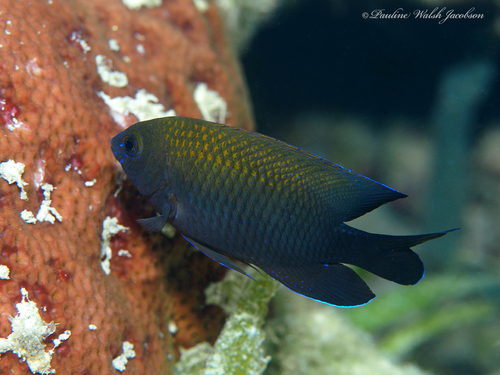
Beaugregory
Stegastes leucostictus
The Beaugregory is the feisty 'gardener' of the Atlantic shallows. With its neon-spotted juvenile phase and fiercely territorial nature, this small damselfish brings big personality to every reef and dockside.
Quick Identification
Size
Typically 8 to 10 cm (3 to 4 inches) in length; weight is usually between 15 and 40 grams (0.5 to 1.4 ounces).
Colors
Juveniles are vibrant yellow with bright blue spots on the upper body; adults fade to a more muted olive-brown or dusky yellow with dark-edged scales.
Key Features
- Brilliant iridescent blue spots along the back and dorsal fin in juveniles
- Small, oval-shaped body with a single, continuous dorsal fin
- Extremely aggressive and territorial behavior near rocky crevices
- Dusky yellow to brownish-olive adult coloration
When You’ll See Them
Geographic range
Where Does the Beaugregory Live?
The Beaugregory is a quintessential resident of the Western Atlantic's warm coastal waters. This species is found from the sun-drenched shores of Florida and the Gulf of Mexico, stretching through the entire Caribbean basin and the Bahamas, and extending as far south as the coast of Brazil. They are particularly abundant in clear, shallow lagoons and reef systems where sunlight can easily reach the sea floor to fuel the growth of their essential algae gardens.
Basemap © OpenStreetMap contributors
Behavior
The Beaugregory is a remarkably feisty and territorial member of the damselfish family. Known as an 'algal farmer,' each individual defends a small patch of the sea floor, where it carefully manages the growth of specific types of algae. They are incredibly protective of these gardens, aggressively chasing away much larger herbivorous fish, such as parrotfish or surgeonfish, that attempt to graze on their crop. Even human divers who get too close may find themselves being 'charged' by these brave little fish.
These fish are strictly diurnal, meaning they are active during the daylight hours and retreat into deep crevices or holes in the reef at night to sleep. Their social structure is defined by these individual territories; while they live in high densities in suitable habitats, they are not schooling fish and will constantly patrol their boundaries. During the breeding season, males become even more aggressive, clearing a nest site on a flat stone or inside a shell and performing zig-zag swimming displays to attract females.
EverydayEarth exclusive
Camera Tips
Capturing high-quality footage of a Beaugregory requires a specialized underwater camera setup, as these fish rarely venture far from their sheltered reef homes. If you have a dock, sea wall, or waterfront property in a tropical region, the best approach is to mount an AI-powered underwater camera to a fixed structure about 2 to 4 feet below the surface. Look for a 'hub' of activity—usually a rock pile or a cluster of coral—where a fish seems to return repeatedly. This is likely its territory, and it provides a predictable stage for your lens.
Placement is everything with damselfish. Position the camera lens about 12 to 18 inches away from a flat, algae-covered rock or a specific crevice. Because Beaugregory are curious and territorial, they will often approach the camera to investigate or 'defend' their territory against the lens, providing excellent close-up opportunities. Avoid using bright artificial lights during the day, as the natural sunlight filtered through the water provides the most realistic color for their iridescent blue spots. However, if your camera is in a shaded area under a dock, a subtle, diffused fill light can help reveal the intricate scale patterns of adults.
While you shouldn't use heavy chum which attracts large predators, you can encourage Beaugregory activity by creating a small 'rock garden' in front of your camera. Using porous limestone rocks with plenty of small holes will encourage them to move in and set up a permanent territory. For the best AI detection, set your camera to a high frame rate (at least 60 fps) to capture their quick, darting movements, and ensure the lens is clean of biofouling or algae every few days to maintain crisp focus on these small subjects.
Similar Species
Species that look similar or are commonly confused with Beaugregory.
Frequently Asked Questions
Record Beaugregory at your habitat
Connect a camera to start building your own species record — AI identifies every visitor automatically.