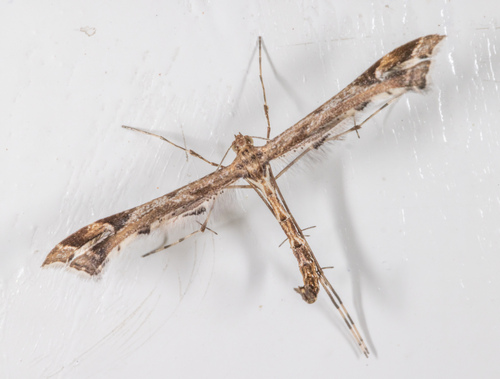
Beautiful Plume Moth
Amblyptilia acanthadactyla
Master of camouflage with a unique T-shaped silhouette, the Beautiful Plume Moth is a common but often overlooked gem of the suburban garden. Its rich mahogany tones and feathery wings make it a favorite for macro photographers and backyard naturalists alike.
Quick Identification
Size
Wingspan of 18–23 mm (0.7–0.9 inches); body length approximately 10–12 mm (0.4–0.5 inches)
Colors
Rich reddish-brown to warm mahogany; wings feature delicate white marbling and a prominent dark brown triangular mark near the wing cleft
Key Features
- Distinct 'T-shaped' resting posture with wings held at right angles to the body
- Deep reddish-brown coloration unlike the greyer tones of similar species
- Feathery, plume-like hindwings (visible during flight)
- Long, slender legs with noticeable spurs and white banding
When You’ll See Them
Geographic range
Where Does the Beautiful Plume Moth Live?
Native to the Palearctic region, the Beautiful Plume Moth is a common sight across Europe, extending from the Mediterranean into Southern Scandinavia. It is also found in parts of North Africa and across Western Asia. In the British Isles, it is particularly well-distributed and is one of the most frequently recorded plume moths in residential gardens due to its preference for common ornamental plants like lavender.
Basemap © OpenStreetMap contributors
Behavior
The Beautiful Plume Moth is a fascinating insect that often surprises backyard observers with its unusual silhouette. Unlike most moths that fold their wings flat or roof-like over their bodies, this species holds its narrow wings out horizontally, creating a rigid T-shape. This posture, combined with its mottled brown coloring, allows it to mimic a piece of dried grass or a small twig, providing excellent camouflage against predators.
This species is double-brooded, meaning it produces two generations per year. The first generation typically appears in late spring, while the second emerges in late summer. Interestingly, the adults of the second generation hibernate through the winter, often seeking shelter in dense evergreen foliage like ivy or even inside unheated garden sheds and outbuildings. They are primarily nocturnal but are easily disturbed from low-growing plants during the day, taking short, jerky flights before settling back into their characteristic cross-like pose.
EverydayEarth exclusive
Camera Tips
Capturing the Beautiful Plume Moth on a backyard camera requires a setup capable of macro photography or very close-range focusing. Because these moths are small and slender, standard wide-angle trail cameras may miss them unless they land directly on the lens. Set your camera to 'Macro' mode if available, or position it approximately 6 to 12 inches away from flowering lavender or geraniums, which are their favorite host plants.
To increase your chances of a sighting, utilize a white LED light or a moth-attracting UV light near your camera station. These moths are strongly attracted to light sources after dark. You can also try 'sugar roping'—painting a mixture of fermented fruit and sugar onto a nearby tree trunk or post. This moth is a frequent visitor to such bait stations during the late summer months.
Placement is key for the Beautiful Plume. Look for sheltered corners of the garden where ivy grows or where there is dense herbaceous cover. Since they hibernate as adults, you can even find them on your camera during mild winter nights or early spring when other insects are still dormant. Ensure your shutter speed is high or use a flash to freeze their delicate wing structure, as they can be twitchy when active.
Frequently Asked Questions
Record Beautiful Plume Moth at your habitat
Connect a camera to start building your own species record — AI identifies every visitor automatically.