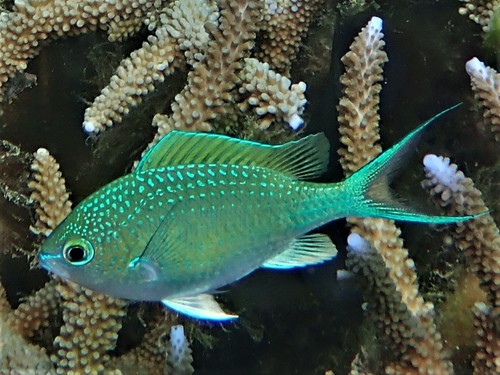
Black-axil Chromis
Chromis atripectoralis
A shimmering icon of the tropical reef, the Black-axil Chromis is famous for its brilliant blue-green scales and its remarkable ability to disappear into coral branches in the blink of an eye.
Quick Identification
Size
Typically grows to 8–10 cm (3.1–3.9 inches), with a maximum length of 12 cm (4.7 inches).
Colors
Brilliant iridescent blue-green to pale turquoise across the body; distinguished by a prominent black spot at the base (axil) of the pectoral fin.
Key Features
- Iridescent blue-green body coloration
- Distinctive black spot at the pectoral fin base
- Deeply forked caudal fin
- Small, upturned mouth for plankton feeding
When You’ll See Them
Geographic range
Where Does the Black-axil Chromis Live?
The Black-axil Chromis is a quintessential resident of the tropical Indo-Pacific. Its expansive range begins in the Red Sea and along the shores of East Africa, stretching across the Indian Ocean to the islands of Southeast Asia and the northern coast of Australia. In the Pacific, they are commonly found from southern Japan down through the Great Barrier Reef and across to the remote archipelagos of Oceania, including Fiji and the Tuamotu Islands. They are exclusively marine and are found in high concentrations wherever healthy branching coral reefs thrive.
Basemap © OpenStreetMap contributors
Behavior
The Black-axil Chromis is a highly social damselfish that spends its life in large, shimmering schools. These groups are almost always found in close association with branching corals, particularly the Acropora species. During the day, the school hovers just above the coral to feed on passing plankton, creating a spectacular display of shifting blue and green light as they catch the sun. At the slightest hint of danger, the entire school will dive into the protective branches of the coral in a synchronized movement, vanishing from sight in an instant.
While they are energetic and constant swimmers, they are generally peaceful and do not exhibit the aggressive territoriality seen in many other damselfish species. They are diurnal, meaning they are active during the daylight hours and retreat deep into the reef crevices or coral thickets at night to sleep. In aquarium or underwater camera settings, they are known for their 'dither' behavior, where their active swimming encourages more shy species to come out into the open.
EverydayEarth exclusive
Camera Tips
To capture the best footage of Black-axil Chromis with an underwater or 'reef-cam' setup, you must focus your efforts on their 'home' coral. Identify a large, healthy head of branching Acropora or Pocillopora coral. These fish rarely stray more than a few feet from their sanctuary. Secure your camera on a weighted base or a low-profile mount approximately 18 to 24 inches from the coral, angling the lens slightly upward to take advantage of natural light filtering from the surface.
Lighting is critical for bringing out their iridescent blue-green hues. The most vivid colors are captured during high noon when the sun is directly overhead. If your AI-powered camera allows for custom settings, use a fast shutter speed or a high frame rate (60fps or higher) because these fish move with incredible agility and speed. Without a high frame rate, their darting movements will appear as a blue blur rather than a distinct fish profile.
While they are wild animals, you can encourage them to stay in frame by utilizing the current. Position the camera so that it faces 'up-current' toward the coral head. As plankton drifts toward the reef, the Chromis will naturally face into the current to feed, providing you with perfect head-on or profile shots. In a backyard reef aquarium, placing the camera near the output of a wavemaker or powerhead will simulate this natural behavior, as the fish love to swim against the flow in a tight group.
Frequently Asked Questions
Record Black-axil Chromis at your habitat
Connect a camera to start building your own species record — AI identifies every visitor automatically.