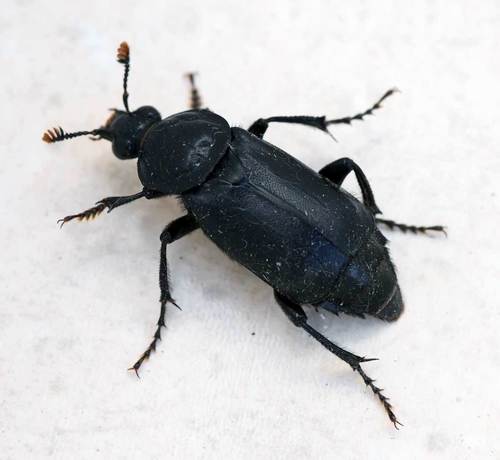
Black Burying Beetle
Nicrophorus humator
The ultimate recycler of the insect world, the Black Burying Beetle is a fascinating 'undertaker' that exhibits rare parental devotion and incredible engineering skills.
Quick Identification
Size
20–35 mm (0.8–1.4 inches) in length
Colors
Uniformly glossy black body with distinctive orange-red tips on the antennae
Key Features
- Solid black elytra without orange bands
- Antennae tipped with bright orange-red clubs
- Large, robust body with strong, spiny legs for digging
- Often carries small, harmless mites on its thorax
When You’ll See Them
Geographic range
Where Does the Black Burying Beetle Live?
The Black Burying Beetle is a widespread resident of the Palearctic realm, stretching across the vast landscapes of Europe and Northern Africa into Western Asia. In Europe, it is a common sight from the British Isles and Scandinavia down to the Mediterranean, while its southern range extends into the coastal regions of Morocco and Algeria. While most concentrated in the temperate forests of Central and Western Europe, its range also reaches eastward through Turkey and into parts of Russia.
Basemap © OpenStreetMap contributors
Behavior
Known as 'Nature’s Undertakers,' Black Burying Beetles perform a vital ecological service by disposing of small animal carcasses. They possess an incredibly sensitive sense of smell, using their orange-tipped antennae to detect the scent of decay from over a mile away. Once a suitable carcass—such as a mouse or small bird—is found, a male and female pair will work together to excavate the soil beneath it, effectively 'burying' the prize to protect it from competitors like flies and crows.
Unlike most insects, these beetles exhibit complex parental care. After burying the carcass and stripping it of fur or feathers, the female lays eggs nearby. Once the larvae hatch, the parents remain with them, feeding them regurgitated liquid food until they are old enough to feed themselves. This social behavior is highly unusual in the beetle world and ensures a high survival rate for their offspring.
While they may seem gruesome to some, they are entirely harmless to humans. They are strictly nocturnal and are frequently attracted to artificial light sources at night. In the garden, they are a sign of a healthy, functioning ecosystem where nutrient recycling is actively taking place.
EverydayEarth exclusive
Camera Tips
To capture the Black Burying Beetle on camera, you must focus on ground-level macro photography. Because these beetles are strictly nocturnal, your camera setup needs a reliable infrared flash or a motion-activated light source. Position your camera as low as possible—literally on the ground—tilted slightly upward to capture the beetle's impressive, bulky silhouette against the leaf litter.
The most effective way to attract this species is by providing a 'bait station.' A small piece of raw meat or a chicken wing placed in a shallow depression in the soil will act as a magnet for their powerful sense of smell. To keep the beetle in the frame for longer, consider tethering the bait or placing it under a heavy wire mesh; this prevents the beetle from immediately dragging the food underground and out of your camera's line of sight.
Use a 'Macro' or 'Close-up' lens setting if your camera supports it. If you are using a trail camera, ensure it has a short minimum focal distance, or the beetle will appear as a blurry black blob. Setting the camera to record short 10-second video clips is often more rewarding than still photos, as it allows you to see their frantic digging motions and the way they use their heads like bulldozers.
Late spring and early summer are the best times for sightings, especially on warm, humid nights after rain. Look for areas with soft, loamy soil where the beetles find it easiest to dig. If your camera has a time-lapse mode, try setting it to trigger every 60 seconds over a carcass; you may be lucky enough to document the incredible sight of a whole animal carcass slowly sinking into the earth as the beetles work beneath it.
Frequently Asked Questions
Record Black Burying Beetle at your habitat
Connect a camera to start building your own species record — AI identifies every visitor automatically.