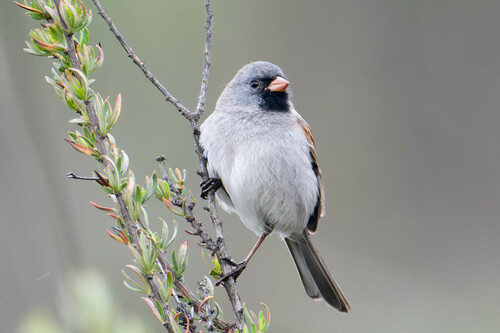
Black-chinned Sparrow
Spizella atrogularis
A subtle gem of the American Southwest, the Black-chinned Sparrow is best known for its bright pink bill and the male's striking black face mask. This shy songbird thrives in the rugged chaparral and desert scrub of the borderlands.
Quick Identification
Size
Length: 5.1–5.5 in (13–14 cm); Wingspan: 7.5–7.9 in (19–20 cm); Weight: 0.3–0.5 oz (9–15 g)
Colors
Primary slate-gray body with a warm reddish-brown (rufous) back streaked with black; distinct pinkish-orange bill. Breeding males have a black chin, throat, and face; females and non-breeding males are mostly gray.
Key Features
- Distinctive bright pink or orange-pink conical bill
- Slender build with a notably long, thin tail
- Black mask and chin on breeding males
- Rufous-streaked back contrasting with an all-gray head
When You’ll See Them
Geographic range
Where Does the Black-chinned Sparrow Live?
Native to the North American continent, the Black-chinned Sparrow primarily inhabits the southwestern United States and high-elevation regions throughout Mexico. Its core breeding range stretches from central California and southern Nevada through Arizona, New Mexico, and into West Texas. While Mexican populations are largely resident year-round, those in the United States typically migrate south to winter in the Mexican interior or the southern tip of Baja California.
Basemap © OpenStreetMap contributors
Behavior
The Black-chinned Sparrow is a somewhat reclusive resident of the arid Southwest, known for its preference for dense, shrubby habitats where it can remain largely out of sight. It is an unobtrusive bird that spends the majority of its time foraging slowly on the ground or low within the undergrowth, often moving with a quiet, hopping gait. While they are usually solitary or found in pairs during the nesting season, they may occasionally join mixed-species flocks of other Spizella sparrows or juncos during the winter months.
Unlike more bold backyard birds, this species rarely ventures far from the safety of thick cover. However, during the breeding season, the male becomes significantly more visible. He will choose a high, exposed perch—such as the top of a tall yucca or manzanita—to deliver his characteristic 'ping-pong ball' song, which starts with slow notes and accelerates into a rapid trill. In terms of human interaction, they are not particularly wary but simply prefer the isolation of rugged canyons and scrublands over busy suburban lawns.
EverydayEarth exclusive
Camera Tips
To capture the Black-chinned Sparrow, placement is everything. These birds are 'edge' specialists, meaning they prefer the transition zones where dense brush meets a small clearing or a rocky outcrop. Set your AI-powered camera at a low height—roughly 12 to 18 inches off the ground—and aim it toward a flat patch of dusty earth where they might forage or take dust baths. Because they are small and blend in with the gray shadows of the brush, ensure your camera is set to a high sensitivity to catch their subtle movements.
Water is the most effective lure for this species in its naturally dry environment. A ground-level birdbath or a simple solar-powered dripper near the edge of thick cover will drastically increase your chances of a sighting. Place the camera 3-5 feet from the water source, ideally with the sun at your back to highlight the subtle pink of the bill and the male's black mask. Avoid placing cameras in wide-open spaces, as these birds feel vulnerable and will rarely stay long enough for a clear photo.
During the spring (late March through June), watch for 'song perches.' Males will often return to the same prominent branch or rock every morning to sing. If you can identify a favorite singing post, mount your camera on a nearby tripod or strap it to a neighboring shrub. Use a fast shutter speed or high-frame-rate video mode to capture the rapid vibration of the throat during their accelerating trill. Since they are active early, ensure your camera's low-light settings are optimized for the dawn chorus.
Similar Species
Species that look similar or are commonly confused with Black-chinned Sparrow.
Chipping Sparrow
Has a prominent white eyebrow and black eyeline, whereas the Black-chinned is mostly gray-faced.
Dark-eyed Junco
Juncos usually have white outer tail feathers and lack the streaked reddish-brown back of the Black-chinned Sparrow.
Brewer's Sparrow
Much browner overall with a streaked crown and lacking the solid gray head and pink bill.
Frequently Asked Questions
Record Black-chinned Sparrow at your habitat
Connect a camera to start building your own species record — AI identifies every visitor automatically.