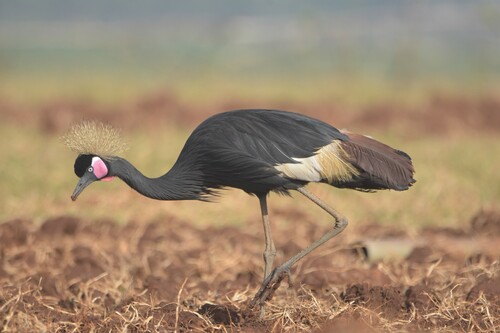
Black Crowned Crane
Balearica pavonina
Adorned with a spectacular golden crest and a regal black plumage, the Black Crowned Crane is a masterpiece of the African wetlands. Witness the intelligence and grace of the only crane species that makes its home in the treetops.
Quick Identification
Size
Height of 90-105 cm (35-41 in), wingspan of 180-200 cm (71-79 in), and weight of 3-4 kg (6.6-8.8 lbs)
Colors
Predominantly slate-black body with large white wing patches; head features a golden bristle crown, white cheek patches with a red upper flush, and a dark bill.
Key Features
- Stiff golden bristle-feathered crown
- White cheek patches with a red upper edge
- Black body plumage and neck
- Large white wing coverts visible in flight
When You’ll See Them
Geographic range
Where Does the Black Crowned Crane Live?
This elegant bird is native to the sub-Saharan African continent, occupying a broad horizontal belt across the Sahel and Sudan-Savanna regions. Its range stretches from Senegal and Guinea in the west, through Mali and Nigeria, and continues eastward into Chad, Sudan, and Ethiopia. You will most often find them inhabiting the fringes of seasonal wetlands that provide the perfect mix of water for safety and dry land for foraging.
Basemap © OpenStreetMap contributors
Behavior
They are generally diurnal, spending their days foraging in pairs or small family groups, though they may congregate in massive flocks of several hundred individuals during the dry season when water sources are scarce. While they are usually wary of humans, they have learned to coexist near agricultural areas where they can find easy meals in the form of spilled grain or insects stirred up by livestock.
EverydayEarth exclusive
Camera Tips
Timing is everything with these cranes. They are most active just after dawn when they descend from their tree roosts and shortly before dusk as they gather to return to the canopy. Set your camera to trigger during these 'golden hours.' If your device has a video mode, use it—their walking gait and 'stamping' foraging technique are much more interesting to watch in motion than in a still photo. Use a fast trigger speed if possible, as their dancing leaps can be surprisingly quick and may result in motion blur on slower cameras.
While these birds are wary of human presence, they are less bothered by stationary objects. Ensure your camera is well-camouflaged with local grasses or a burlap wrap to break up its silhouette. No-glow or 'black' infrared LEDs are highly recommended if you hope to catch them at the very edge of daylight, as standard red-glow LEDs can sometimes startle them. If you are on a farm or large property, setting the camera near a shallow water trough or a recently harvested grain field can significantly increase your chances of a close-up encounter.
Similar Species
Species that look similar or are commonly confused with Black Crowned Crane.
Frequently Asked Questions
Record Black Crowned Crane at your habitat
Connect a camera to start building your own species record — AI identifies every visitor automatically.