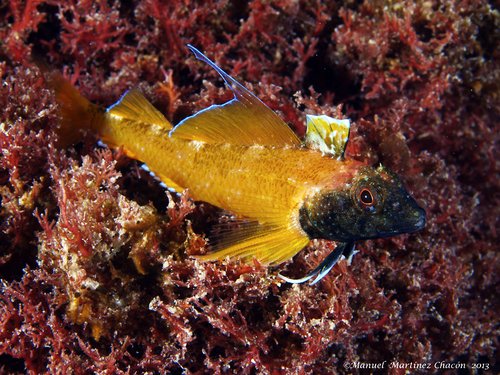
Black-faced Blenny
Tripterygion delaisi
A vibrant jewel of the Mediterranean reef, the Black-faced Blenny is a master of transformation. From a camouflaged rock-dweller to a golden-bodied showstopper, this tiny fish brings a burst of color to the underwater world.
Quick Identification
Size
Typically 4–7 cm (1.5–2.8 inches) in length, with a maximum size reaching up to 9 cm (3.5 inches).
Colors
Non-breeding individuals and females are mottled brown, grey, and white for camouflage. Breeding males display a striking jet-black head and a brilliant yellow or orange-yellow body.
Key Features
- Three distinct dorsal fins (triplefin family)
- Jet-black head on males during breeding season
- Large, upward-facing eyes with mobile pupils
- Pointed snout and slender, tapering body
When You’ll See Them
Geographic range
Where Does the Black-faced Blenny Live?
The Black-faced Blenny is a charismatic resident of the Northeastern Atlantic Ocean and the Mediterranean Sea. Its range begins as far north as the southern coasts of Great Britain and Ireland, extending southward along the Atlantic coastlines of France, Spain, and Portugal down to Senegal and the Canary Islands. It is particularly abundant throughout the Mediterranean basin, where it thrives in the clear, temperate waters of rocky coastal zones.
Basemap © OpenStreetMap contributors
Behavior
The Black-faced Blenny is a highly territorial benthic fish that spends most of its life perched on rocky substrates. Unlike many fish that swim continuously in the water column, this species uses its pectoral fins to 'sit' on ledges or vertical cliff faces, making quick, darting movements to move from one spot to another. They are generally solitary, with males establishing strict territories on rocky overhangs or inside crevices, which they defend vigorously against rivals.
During the breeding season, which typically runs from spring through summer, the males undergo a dramatic physical transformation. They lose their cryptic brown camouflage and develop their namesake black face and golden body to attract mates. They perform complex 'looping' swimming displays to entice females to lay eggs in their territory, which the male then guards until they hatch. While they are naturally skittish around large predators, they are remarkably curious and will often watch divers or underwater cameras from a safe distance.
EverydayEarth exclusive
Camera Tips
Capturing the Black-faced Blenny requires a specialized underwater camera setup, such as an AI-powered reef cam or an action camera in a waterproof housing. Because these fish live on vertical surfaces and under overhangs, position your camera facing a rocky ledge or a crevice entrance. Using a macro lens or setting your camera to a close-focus mode is essential, as these fish are small and detail-oriented identification relies on seeing their three dorsal fins and facial markings.
Lighting is your biggest challenge at depth. If your camera is deeper than 5 metres, the red spectrum of light is lost, making the fish appear dull. Use a dedicated underwater video light with a high CRI (Color Rendering Index) to bring out the brilliant yellows of the breeding males. Aim the light slightly away from the center to avoid 'backscatter' from particles in the water, which can confuse AI motion sensors.
Placement is key to capturing natural behavior. Look for a 'perch'—a flat rock near a crevice that looks like a good lookout spot. If you are using a stationary camera, leave it in place for several hours. The blenny will eventually accept the camera as part of the reef and return to its territorial displays. For the best results, set your camera to trigger on movement, focusing the frame on a 30cm area of rock where you've seen a fish previously darting.
Frequently Asked Questions
Record Black-faced Blenny at your habitat
Connect a camera to start building your own species record — AI identifies every visitor automatically.